Air Navigation Fundamentals: Distance, Speed & Time Calculations
360 likes | 456 Views
Learn to calculate aircraft distance, speed, time, and explore vector principles. Understand compass systems and weather hazards in aviation. Comprehend the 1 in 60 rule and latitude/longitude grids. Discover how to determine aircraft positions and calculate distances. Master aircraft speed measurements using knots and the function of instruments such as the Air Speed Indicator. Dive into air pressure measurements, corrections, and true air speed computations. Acquire knowledge of time units and calculations for time of flight.


Air Navigation Fundamentals: Distance, Speed & Time Calculations
E N D
Presentation Transcript
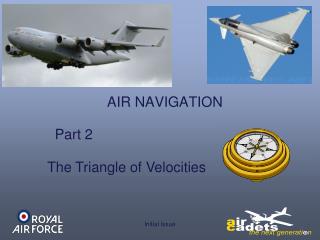
AIR NAVIGATION Part 1 Distance Speed & Time
LEARNING OUTCOMES On completion of this unit, you should: • Be able to carry out calculations to determine aircraft distance, speed and time • Understand the principles of vectors and the triangle of velocities to establish an aircraft’s track and ground speed
LEARNING OUTCOMES • Understand the principles of the 1 in 60 rule • Understand the types of compass systems used for air navigation, how they work and their limitations • Know the hazards that weather presents to aviation
RECAP • Latitude/Longitude grid divides the surface of the Earth into degrees and minutes • One minute of latitude represents one nautical mile (nm) • 1 degree of latitude (60 minutes) equals 60nm
As a complete circle is 360° then 360 x 60 gives the circumference of the Earth as 21600 nm (approx 25000 statute miles).
Lines of Longitude are sometimes referred to as MERIDIANS • When recording your position – the line of Latitude must be given first. • The starting point goes through Greenwich and is referred to as the: “Prime Meridian”
Finding Distance Between 2 Points • Use a ruler and dividers • If you do not have any equipment, using the marks along the edge of any piece of paper
Change of Latitude • If two places are on the same meridian then it is possible to calculate the distance between them rather than having to measure it • For example Torrejon airfield (near Madrid in Spain) is due south of RAF St Athan. These two latitudes are N40º29’ and N51º24’ • How would we calculate the distance between them?
Calculation N 51º 24’ First Latitude: Second Latitude: N 40º 29’ Subtracting gives: 10º 55’ To convert 10º 55’ into nautical miles: 10º multiply by 60 = 600 Add the 55’ = 655 nm
Aircraft Speed • The speed for cars, motorcycles and other land-based vehicles: • Miles per hour • For aircraft, the speed is a measure of: • Nautical Miles per hour – (Knots)
Aircraft Speed • We cannot use a speedometer to record aircraft speed. • The aircraft flies through the air. • We use an instrument called an Air Speed Indicator (ASI)
A simplified ASI Aircraft Speed • ASI measures the dynamic air pressure • Dynamic Air Pressure is the pressure caused by forward motion of the aircraft
A simplified ASI Aircraft Speed • In forward flight the pressure above the diaphragm will consist of Dynamic + Static. • Below, the pressure is just Static • The two static pressures cancel out and the diaphragm will move due to the dynamic pressure.
Aircraft Speed • The movement due to dynamic pressure is amplified and displayed on the instrument as Indicated Air Speed (IAS), reading in knots.
Corrections • The reading on the ASI can be in error because of two errors, namely Pressure Error and Instrument Pressure. • Instrument error is caused by poor manufacturing tolerances when the instrument was built.
Corrections • Pressure Error previously known as position is caused by sensing incorrect values of static pressure due to the position of the static vents relative to the airflow around the aircraft. • Both errors can be measured by testing the aircraft under controlled conditions and a calibration card with the combined errors is displayed in the cockpit next to the instrument.
Calibrated Air Speed • Once the two errors have been accounted for, we are left with Calibrated Air Speed (CAS), formerly known as Rectified Air Speed (RAS). • IAS ± Pressure Error ± Instrument Error = CAS • Thus an IAS of 118 kts with a correction on the calibration card of +2 kts would give a CAS of 120 kts.
True Air Speed (TAS) • To obtain True Air Speed (TAS) from CAS you need to correct for air density changes caused by changes in temperature and altitude. • This can be done by calculation or by Navigation Computer.
TAS • If you are flying at speeds greater than 300 kts, then you need to apply a correction for Compressibility Error, which is caused by air becoming compressed in the Pitot Tube. CAS ± Density Error + Compressibility Error = TAS
Units of Time • Time is probably the only example of scientific measurement where every nation uses the same units. • Everyone is familiar with days, hours and minutes; it is only necessary to ensure that you use hours when working with knots as this speed is nautical miles per hour.
Units of Time • In military and commercial aviation the 24 hour clock is used, set to Greenwich Mean Time GMT or Coordinated Universal Time (UTC) as it is now known. • UTC can also be known as Zulu Time • Summer Time or Daylight Saving Time is always ignored.
Calculation of Time of Flight(Still Air) • If a car travels 120 miles at 60 mph, it will take 2 hours to complete the journey. • This is calculated using the distance speed time formulae
Provided 2 quantities are known From Speed Distance and Time The 3rd one can be calculated using the following formula
Distance Speed Time Calculation Triangle (Still Air)
DISTANCE (D) = SPEED (S) TIME(T) DISTANCE (D) = TIME (T) SPEED (S) = DISTANCE SPEED (S) x TIME (T)
Example: How fast must we go to cover 1500 nm in 5 hours? Quantities known are: Distance Time
DISTANCE (D) = SPEED (S) TIME(T) Therefore we use the following formulae: 3 Therefore: 1500 nm 300 S (Knots) = = 5 hours 1
Check of Understanding One degree of latitude represents: 1 nm 6 nm 60 nm 360 nm
Glasgow is due north of Plymouth (approximately on the same meridian). If Glasgow is latitude 55°50’ and Plymouth is latitude 50°25’ what distance are the two places apart?: 450 nm 525 nm 275 nm 325 nm
55° 50’ - 50° 25’ 55 – 50 = 5 5 x 60 = 300 50 – 25 = 25 300 + 25 = 325nm
In the RAF, aircraft speeds are generally expressed in: metres per second miles per hour nautical miles per second Knots
An ASI has an instrument correction factor of +3 kts and a pressure correction factor of -1 Kts. If the instrument reads 130 kts what is the CAS? 130 Kts 132 Kts 133 Kts 134 Kts
IAS ± Pressure Error ± Instrument Error = CAS 130 kts + 3 kts – 1 kts = CAS 133 kts – 1 kts = CAS 132 kts = CAS
A Tornado is flying at a TAS of 400 kts. How far will it travel in 2 hrs? 200 nm 200 Km 800 nm 800 Km
= DISTANCE SPEED (S) x TIME (T) D = 400 kts x 2 hrs D = 400 x 2 = 800 Kts = Nautical Miles per hour 800 Nautical Miles 800 nm