Download
1 / 3
30 likes | 175 Views
This document outlines the conversion process from a sequential filter to an epoch state filter in time-series analysis. Given a set of initial conditions with no observations, we begin with a measurement update. The goal is to compute the conversion process effectively, applying time updates and measurement updates using the sequential filter methodology. It presents a step-by-step approach to substituting variables and performing necessary calculations, ensuring clarity for practitioners aiming to adapt their algorithms for evolving data conditions.

E N D
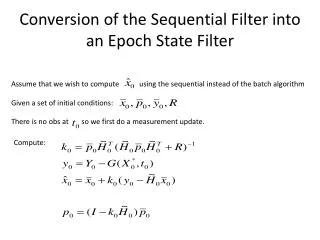
Conversion of the Sequential Filter into an Epoch State Filter Assume that we wish to compute using the sequential instead of the batch algorithm Given a set of initial conditions: There is no obs at so we first do a measurement update. Compute:
Conversion of the Sequential Filter into an Epoch State Filter Now do a time update to Compute the measurement update at Substitute for
Conversion of the Sequential Filter into an Epoch State Filter We wish to write this in terms of . Use Hence Multiplying by If there is no obs at use and to obtain