Probability Assessments for Gender and Eye Color in a Class of 28 Children
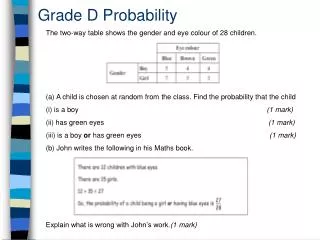
This document presents a two-way table illustrating the gender and eye color distribution of 28 children. It includes probability calculations based on randomly selecting a child from the class. Specific tasks involve finding the probabilities of selecting a boy, a child with green eyes, and the combined probability of being either a boy or having green eyes. Additionally, it critiques an error made by John in his math deduction, requiring an explanation of the mistake. Understanding these concepts enhances comprehension of basic probability principles.

Probability Assessments for Gender and Eye Color in a Class of 28 Children
E N D
Presentation Transcript
Grade D Probability The two-way table shows the gender and eye colour of 28 children. (a) A child is chosen at random from the class. Find the probability that the child (i) is a boy (1 mark) (ii) has green eyes (1 mark) (iii) is a boy or has green eyes (1 mark) (b) John writes the following in his Maths book. Explain what is wrong with John’s work.(1 mark)
Grade D Probability - answers The two-way table shows the gender and eye colour of 28 children. (a) A child is chosen at random from the class. Find the probability that the child (i) is a boy 13/28(1 mark) (ii) has green eyes 7/28 = ¼(1 mark) (iii) is a boy or has green eyes 16/28 = 4/7 (1 mark) (b) John writes the following in his Maths book. Explain what is wrong with John’s work.(1 mark)