Understanding Octet Rule Exceptions in Central Atoms and Ligands
10 likes | 140 Views
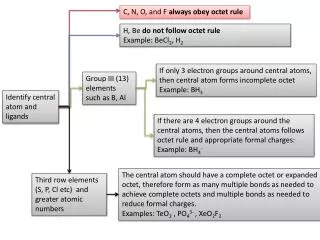
This guide explores the nuances of the octet rule, differentiating between elements that always follow it (C, N, O, F) and those that do not (H, Be). It explains how central atoms may form incomplete octets with few electron groups, as seen in compounds like BH3. The concept of formal charges is introduced, detailing how to achieve complete or expanded octets through multiple bonds. Examples such as TeO2, PO4^3-, and XeO2F2 illustrate the behavior of third-row elements and heavier ones.


Understanding Octet Rule Exceptions in Central Atoms and Ligands
E N D
Presentation Transcript
C, N, O, and F always obey octet rule H, Be do not follow octet rule Example: BeCl2, H2 If only 3 electron groups around central atoms, then central atom forms incomplete octet Example: BH3 Group III (13) elements such as B, Al Identify central atom and ligands If there are 4 electron groups around the central atoms, then the central atoms follows octet rule and appropriate formal charges: Example: BH4- The central atom should have a complete octet or expanded octet, therefore form as many multiple bonds as needed to achieve complete octets and multiple bonds as needed to reduce formal charges. Examples: TeO2, PO43- , XeO2F2 Third row elements (S, P, Cl etc) and greater atomic numbers