Understanding Virtual Memory and Synchronization in Modern Computing
This document explores the concepts of virtual memory and synchronization in computational systems. It covers essential topics such as demand paging, page faults, Copy-on-Write techniques, and memory-mapped files. The document aims to simplify complex ideas and highlights the performance implications of virtual memory, including fragmentation and efficient memory sharing. Additionally, it addresses the mechanics of page table management, error handling during memory access, and optimum strategies for page replacement and process handling.

Understanding Virtual Memory and Synchronization in Modern Computing
E N D
Presentation Transcript
Dave Eckhardt de0u@andrew.cmu.edu Virtual Memory
Synchronization • P2 hand-in • Web page will appear • Same basic idea as last time • Will try to make it simpler • Extra office hours (see bboard) • Upcoming • P3 out: Friday (checkpoint upcoming) • HW1; exam
Outline • Previously • Hardware used for paged memory • What virtual memory can do for me • What's under the hood
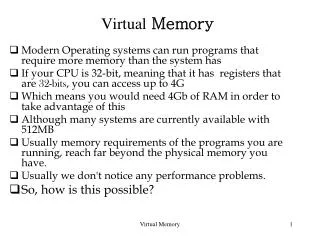
Virtual Memory: Motivations • Previously • Avoid fragmentation issues of contiguous segments • Avoid “final relocation” • Enable “partial swapping” • Share memory regions, files efficiently • Big speed hack for fork()
Partial Memory Residence • Error-handling code not used in every run • Tables may be allocated larger than used • Can run very large programs • Much larger than physical memory • As long as “active” footprint fits in RAM • Swapping can't do this • Programs can launch faster • Needn't load whole thing
Demand Paging • RAM frames form a cache for the set of all pages • Page tables indicate which pages are resident • “valid” bit in page table entry (PTE) • otherwise, page fault
Page fault - Why? • Address is invalid/illegal • Raise exception • Process is growing stack • “Cache misses” • Page never used • Fetch from executable file • Page “swapped” to disk • Bring it back in!
Page fault story - 1 • Process issues memory reference • TLB: miss • PT: invalid • Trap to OS kernel! • Save registers • Load new registers • Switch to kernel's page table • Run trap handler
Page fault story – 2 • Classify fault address: legal/illegal • Code/data region of executable? • simulate read() into a blank frame • Heap/modified-data/stack? • “somewhere on the paging partition” • schedule disk read into blank frame • Growing stack? • Allocate a zero frame, insert into PT
Page fault story – 3 • Put process to sleep (probably) • Switch to running another • Complete I/O, schedule process • Handle I/O-complete interrupt • mark process runnable • Restore registers, switch page table • Faulting instruction re-started transparently • Single instruction may fault more than once!
Demand Paging Performance • Effective access time of memory word • (1 – pmiss) * Tmemory + pmiss * Tdisk • Textbook example • Tmemory 100 ns • Tdisk 25 ms • pmiss = 1/1,000 slows down by factor of 250 • slowdown of 10% needs pmiss < 1/2,500,000
Copy-on-Write • fork() produces two very-similar processes • Same code, data, stack • Expensive to copy pages • Many will never be modified by new process • Especially in fork(), exec() case • Share instead of copy? • Easy: code pages – read-only • Dangerous: stack pages!
Copy-on-Write • Simulated copy • Copy page table entries to new process • Mark PTEs read-only in old & new • Done! (saving factor: 1024) • Making it real • Process writes to page (oops!) • Page fault handler responsible • Copy page into empty frame • Mark read-write in both PTEs
Zero pages • Very special case of copy-on-write • Many process pages are “blank” • All of bss • New heap pages • New stack pages • Have one system-wide all-zero page • Everybody points to it • Cloned as needed
Memory-Mapped Files • Alternative interface to read(),write() • mmap(addr, len, prot, flags, fd, offset) • new memory region presents file contents • write-back policy typically unspecified • Benefits • Avoid serializing pointer-based data structures • Reads and writes may be much cheaper • Look, Ma, no syscalls!
Memory-Mapped Files • Implementation • Memory region remembers mmap() parameters • Page faults trigger read() calls • Pages evicted via write() to file • Shared memory • Two processes mmap() “the same way” • Point to same memory region
Memory Regions vs. Page Tables • What's a poor page fault handler to do? • Kill process? • Copy page, mark read-write? • Fetch page from file? Which? Where? • Page Table not a good data structure • Format defined by hardware • Per-page nature is repetitive • Not enough bits to encode OS metadata
Dual-view Memory Model • Logical • Process memory is a list of regions • “Holes” between regions are illegal addresses • Per-region methods • fault(), evict(), unmap() • Physical • Process memory is a list of pages • Many “invalid” pages can be made valid • Faults delegated to per-region methods
Page-fault story (for real) • Examine fault address • Look up: address region • region->fault(addr, access_mode) • Quickly fix up problem • Or put process to sleep, run scheduler
Page Replacement – When • Process always want more memory frames • Explicit deallocation is rare • Page faults are implicit allocations • System inevitably runs out • Solution • Pick a frame, store contents to disk • Transfer ownership to new process • Service fault using this frame
Pick a Frame • Two-level approach • Determine # frames each process “deserves” • Process chooses which frame is least-valuable • System-wide approach • Determine globally-least-useful frame
Store Contents to Disk • Where does it belong? • Allocate backing store for each page • What if we run out? • Must we really store it? • Read-only code/data: no! • Can re-fetch from executable • Saves space, may be slower • Not modified since last page-in: no! • Hardware may provide “page-dirty” bit
FIFO Page Replacement • Concept • Page queue • Page added to queue when created/faulted in • Always evict oldest page • Evaluation • Cheap • Stupid • May evict old unused startup-code page • But guaranteed to evict process's favorite page too!
Optimal Page Replacement • Concept • Evict whichever page will be referenced latest • Buy the most time until next page fault • Evaluation • Impossible to implement • So? • Used as upper bound in simulation studies
LRU Page Replacement • Concept • Evict least-recently-used page • “Past performance may not predict future results” • Evaluation • Would work well • LRU is computable without fortune teller • Bookkeeping very expensive • Hardware must sequence-number every page reference!
Approximating LRU • Hybrid hardware/software approach • 1 reference bit per page table entry • OS sets reference = 0 for all pages • Hardware sets reference=1 when PTE is used • OS periodically scans for active pages • Second-chance algorithm • FIFO chooses victim page • Skip victims with reference == 1
Clock Algorithm static int nextpage = 0; boolean reference[NPAGES]; int choose_victim() { while (reference[nextpage]) reference[nextpage] = false; nextpage = (nextpage+1) % NPAGES; return(nextpage);
Page Buffering • Maintain a pool of blank pages • Page fault handler can be fast • Disk write can happen in background • “page-out daemon” • Scan system for dirty pages • Write to disk • Clear dirty bit • Page can be instantly evicted later
“Reclaim” fault • DEC VAX-11/780 had no reference bit • What to page out? • Approach • Remove pages from PT's according to FIFO • Dirty pages queued to disk, then marked clean • Add clean pages to FIFO free-page list • Page fault can “re-claim” page from free-page list • “Yes, I was using that page”
Frame Allocation • How many frames should a process have? • Minimum • Examine worst-case instruction • Can multi-byte instruction cross page boundary? • Can memory parameter cross page boundary? • How many memory parameters? • Indirect pointers?
Frame Allocation • Equal • Every process gets same # frames • “Fair” • Probably wasteful • Proportional • Larger processes get more frames • Probably the right approach • Encourages greediness
Thrashing • Problem • Process needs N pages • OS provides N-1, N/2, etc. • Result • Every page OS evicts generates “immediate” fault • More time spent paging than executing • Denial of “paging service” to other processes
Working-Set Model • Approach • Determine necessary # pages • If unavailable, start swapping • How to measure? • Periodically scan process reference bits • Combine multiple scans (see text) • Evaluation • Expensive
Page-Fault Frequency • Approach • Thrashing == “excessive” paging • Adjust each frame quotas to balance fault rates • Fault rate “too low”: reduce quota • Fault rate “too high”: increase quota • What if quota increase doesn't help? • Start swapping
Program optimizations • Locality depends on data structures • Arrays encourage sequential accesss • Random pointer data structures scatter references • Compiler & linker can help • Don't split a routine across two pages • Place helper functions on same page as main routine • Effects can be dramatic
Summary • Process address space • Logical: list of regions • Hardware: list of pages • Fault handler is complicated • Page-in, copy-on-write, zero-fill, ... • Understand definition & use of • Dirty bit • Reference bit