Download
1 / 6
60 likes | 191 Views
This document outlines proposals by GTB and OICA regarding regulations on vehicle direction indicators, focusing on the activation of telltales for failure detection in multi-light source systems. It discusses the advantages of LED technology, including improved visibility and reduced wattage for fuel economy. The document highlights potential failure detection issues, emphasizing the need for a reliable system that can identify failures effectively. LD integration strategies and compliance with ECE-R.6 photometric standards are also presented to ensure consistent light intensity.

E N D
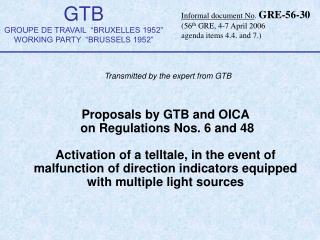
Informal document No. GRE-56-30 (56th GRE, 4-7 April 2006 agenda items 4.4. and 7.) Transmitted by the expert from GTB Proposals by GTB and OICA on Regulations Nos. 6 and 48Activation of a telltale, in the event of malfunction of direction indicators equipped with multiple light sources
Advantages of LED – direction indicators: improvement of visibility lifetime as vehicle (filament lamps are wear parts) reduce of wattage (fuel economy) Failure indication: not possible with detection of current variation because resistance varies in respect to temperature depends on wiring is contradictory to high reliability of the system
Series Connection DC/DC Converter 13,5V Each failure can be detected and indicated.Each failure of LED or electronic leads to a total breakdown of the system. Reliability of the DI-function is on a level with a one-filament-lamp-system.
Parallel Connection in Groups F: Failure detection electronic Failure indication F F F 13,5V Each failure can be detected and indicated, the whole series of LED fails after a failure of one LED. Problems: The lamp must comply when one light source has failed. Electronics for failure detection and wiring doubles price of LEDs for DI.
Matrix Connection Failure indication 13,5V When a second LED in a row fails it leads to an immediate break down of the third LED.This failure can be detected and indicated by the same means as used for a one filament lamp system.
ECE-R 6 Photometric ECE-R 6 photometric was created for a single filament lamp and one reflector system. GTB/OICA proposal ECE-TRANS-WP29-GRE-2006-26 to amend ECE-R 6 is based on this existing light distribution. This means that in 10° horizontal 35 % of light intensity is required. For failure indication the proposal requires 50% light intensity of HV as minimum.