Multi-Phase Process Mining: Building Instance Graphs for Event-Driven Process Chains
This document explores the concept of instance graphs as a method for modeling and analyzing process instances in the context of multi-phase process mining. It discusses how instance graphs correspond to Petri nets and Event-driven Process Chains (EPCs), providing a graphical representation of causal relationships within a process instance. The paper outlines the structure of instance nets and how to generate these graphs from event logs, as well as highlights key features such as causal ordering and instance ordering. Examples are provided, illustrating the practical application of these concepts.

Multi-Phase Process Mining: Building Instance Graphs for Event-Driven Process Chains
E N D
Presentation Transcript
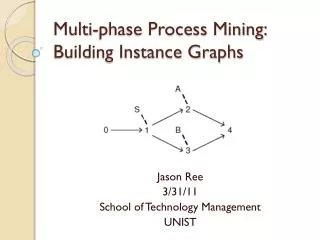
Multi-phase Process Mining:Building Instance Graphs Jason Ree 3/31/11 School of Technology Management UNIST
Introduction: Instance Graphs • Instance Graph • Corresponds to a specific class of Petri nets known as marked graphs, T-systems or partially ordered runs • An abstraction of the instance onto instance Event-driven Process Chains (EPCs) • Instance EPC • Describes the control-flow of a case (i.e. a single process instance) • Provides a graphical representation describing the causal relations
1.1 Process Instance • In other words, • Process Instance of length n: σ = t1t2 … tn∈ T+ , where ti are tasks • W ∈ T+ N denotes a bag (multiset of process instances) • W(σ): the number of times a process instance of the form σ appears in the log T+ σ T
1.2 Instance Domain • Instance Net: a model of one instance • Since events that appear multiple times in a process instance have to be duplicated in an instance net, we define an instance domain to be used as a basis for generating instance nets • In an instance net, the instance σ is extended with some ordering relation to reflect some causal relation.
1.3 Instance Net • Also • Since the set of entries is given as a log, and an instance mapping can be inferred for each instance based on textual properties, only the ordering relation based on the given log needs to be defined. • In other words, • An instance net is defined only as a set of entries from the log and an ordering on that set • Instance nets require • 1. sequence of events σ∈ T+as they appear in a specific instance • 2. ordering on the domain of σ is required Instance Net (σ, )
2.1 Causal Ordering • Example • Causal ordering inferred on T • S wA • S w B T = {S, A, B}
2.2 Instance Ordering • Example • where case 1 = σ1 and case 2 = σ2 • σ1 = SAB and Dσ1 = {1,2,3} • Using the causal relation the relation is inferred such that 1 2 and 1 3 Instance Net (σ, )
2.3 Instance Graph • In other words, • An instance graph is a graph where each node represents one log entry of a specific instance and can be used as a basis to generate models in a particular language • Also it is a graph that typically describes an execution path of some process model, as well as causal relations between tasks
3.1 Instance Event-driven Process Chains (Instance EPCs) • Note: • An instance EPC doesn’t contain any connectors other than AND-split and AND-joins connectors • There is exactly one initial event and one final event
4.1 Example of Multi-Phase Process Mining Using ProM • Open Log data using ProM
4.1 Example of Multi-Phase Process Mining Using ProM • Select Multi-Phase Macro Plugin • Mining > Multi-phase Macro Plugin
4.1 Example of Multi-Phase Process Mining Using ProM • Configure Options as needed for analysis
4.1 Example of Multi-Phase Process Mining Using ProM • Visualization and Analysis of Event Log Data
5. Example • 1. Process Log • 2. Finding Causal Relations • {SA, AB, AC, AD, AE, BF, DH, EH, FG, CG, HG, GT}
5. Example • 3. Creation of Instance Graph • 1) Instance ordering from Causal Relations • 0 1, 1 2, 2 3, 3 4, 4 8, 8 9, 2 5, 5 8, 2 6, 6 7, 7 8, 8 9, 9 10 • 2) Drawing Instance Graph from Instance Ordering
5. Example • 4. Conversion of Instance Graph into Instance EPC
Thank you! • Questions?