Download
1 / 8
80 likes | 195 Views
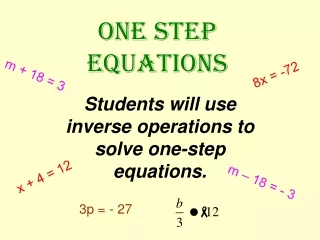
This lesson introduces essential vocabulary and techniques for solving one-step equations using number sense. An equation is a mathematical sentence with an equal sign, while an open sentence contains variables. A solution is a value that satisfies the equation. We'll explore estimation methods to solve algebraic equations using number properties like identity, commutative, and associative. Example problems illustrate how to find unknown values. Engage with class activities and practice with the Poodle Game to reinforce learning concepts.

E N D
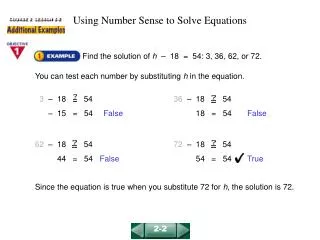
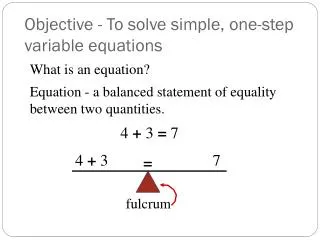
Vocabulary An equation is a mathematical sentence that has an equal sign. An open sentence is an equation with one or more variables in it. A solution is a value that can be substituted for a variable to make the equation true. Example: In the equation y + 3 = 8, the solution is 5.
Using Estimation • Use mental math or estimating to determine the solutions to the equations. • The same number properties apply to algebraic equations.
Properties Identity Properties: a + 0 = a1a = a Commutative Properties: a + b = b + aab = ba Associative Properties: a + (b + c) = (a + b) + ca(bc) = (ab)c
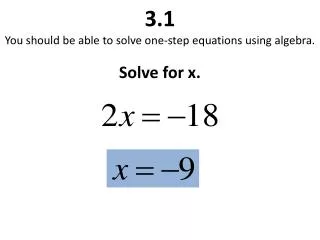
Example: 4x=32 Think: What times 4 equals 32? Solution: x = 8 Check the original equation: 4x=32 4(8)=32 32=32
Example: Estimatep ÷ 4 = 7.97 7.97 is close to 8. So think: What divided by 4 equals 8? If we work backwards, we know that 8 x 4 = 32. Therefore, p is about equal to 32.
Is the given number a solution to the equation? 6n = 17; 3 Try the value out and see if it works. 6n = 17 6(3) = 17 18 = 17 This is not true, so 3 is not a solution.
ClassworkYou can use an equation - a statement that two different expressions are equal to each other - to find unknown values that make the equation true. This game introduces the concept of variables-- that something can be a 'container' for a number. You can learn more about equations by playing The Poodle Game. The poodles have lost the numbers that usually show up on their shirts. By placing each poodle on a scale and adding weights, the player can determine what number the poodle is. Homework p. 86, 1-53 ODD