Understanding Mixtures: Heterogeneous, Homogeneous, Suspensions, and Solutions
This chapter explores the different types of mixtures: heterogeneous and homogeneous. Heterogeneous mixtures have unevenly mixed substances with visible separation, while homogeneous mixtures appear uniform with no visible separation. Key concepts include suspensions (visible particles that settle), colloids (uniform appearance except under a microscope), and the Tyndall Effect (light scattering). The chapter further discusses solutions, their components (solute and solvent), and methods for calculating concentration, including molarity. Practical problems illustrate how to determine molarity from given data.

Understanding Mixtures: Heterogeneous, Homogeneous, Suspensions, and Solutions
E N D
Presentation Transcript
Solutions Chapter 15
Mixtures • Heterogeneous mixture- unevenly mixed substance (separation can be seen) • Homogeneous mixture- evenly mixed substance (no separation can be seen)
Suspensions • ~Small but visible particles suspended or floating in a gas or liquid (heterogeneous mixture) • Like a snow globe or dust or “shake before using” • the particles are too big to float forever without being stirred • If a suspension sits, the particles will settle • Can be filtered out
Colloids or Colloidal Suspension • ~mixture that appears uniform unless under a high powered microscope. • Particles are a little larger than the wavelength of light • Extremely light particles float almost indefinitely. • Milk, blood, smoke • These can be separated in a centrifuge
Tyndall Effect • ~Scattering of light by a colloid or suspension • Both a colloid and a suspension have particles larger than the wavelength of light, so when light shines through it should be deflected every which way. • This will make the beam of light visible.
Solutions • Particles are smaller than the wavelength of light. Therefore, it will not scatter light. • With solutions, no separation can be seen even under a high powered microscope. • Cannot be separated by any filter or by a centrifuge. • Can be separated by boiling/ melting points. • salt water, metal alloys, air
Tyndall Effect Colloid/suspension solution
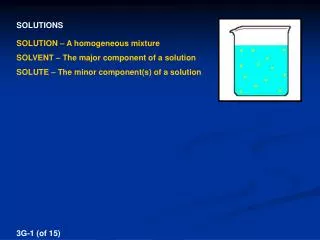
Parts of a solution • Solvent- what the substance is dissolved in • Solute- what is being dissolved • Water is called the “universal solvent” • because it dissolves a lot of substances and is very common. • Water solutions are called aqueous.
Solution misconceptions • Solutions don’t have to be a solid in a liquid. • carbonated water is CO2 dissolved in water, streams have dissolved O2 in them. • The solvent doesn’t have to be water or even a liquid. • Alloys (two or more metals) are a solution as is air. Several things dissolve in oils.
Concentration • ~How much solute is present in a solution compared to the solvent. • Molarity (M)- moles of solute per liter of solution. M = mol/L • 2.1 M AgNO3 means 2.1 mol of AgNO3 for every one liter of solution
Molarity Problems Molarity = mol/L Molarity = moles of solute / Liters of solution
How many moles of HCl are in 125 mL of 2.5 M HCl? Molarity problems .125 L of soln = .31 mol HCl
Here we go • What concentration solution would be prepared if 39 g of Ba(OH)2 were mixed in a 450 mL solution? =.2276 mol Ba(OH)2 M = mol/L .2276 mol Ba(OH)2 .45 L of solution =.51 M Ba(OH)2
More • For a lab in this chapter, I need to make .60 L of 3.0 M NaOH, what mass of NaOH did I need? • .6 L x 3.0 M NaOH = 1.8 mol NaOH • 1.8 mol NaOH x 39.998 g/mol • = 72 g NaOH
Molarity Problems • A 0.24 M solution of Na2SO4 contains 0.36 moles of Na2SO4. How many liters were required to make this solution? 0.36 mol Na2SO4 1 L soln 0.24 mol = 1.5 L Na2SO4
Getting tougher 2 2 • AgNO3 + BaCl2 AgCl + Ba(NO3)2 • Balance the equation. If 1.2 L of .50 M AgNO3 is reacted completely, what molarity solution of Ba(NO3)2 will be created if the volume increased to 1.5 L? 1.2 L x .5 M AgNO3 = .6 mol AgNO3 = .3 mol Ba(NO3)2 1.5 L = .20 M Ba(NO3)2
2 • HNO3 + Zn H2 + Zn(NO3)2 • If you have .65 L of 1.2 M HNO3 and you react it completely what volume of H2 gas will you produce at STP? 1.2 M HNO3 x .65 L = .78 mol HNO3 =.39 mol H2 = 8.7 L at STP
2 • HNO3 + Zn H2 + Zn(NO3)2 • If you have .65 L of 1.2 M HNO3 and you react it completely, what conc. of Zn(NO3)2 will be left if the volume increases to .75 L? 1.2 M HNO3 x .65 L = .78 mol HNO3 = .39 mol Zn(NO3)2 .75 L = .52 M Zn(NO3)2
2 3 3 • Fe + H2SO4 Fe2(SO4)3 + H2 • If 350 mL of 2.3 M H2SO4 is completely reacted, what is the volume of hydrogen gas produced at 24o C and 114 kPa? .35 L x 2.3 M = .805 mol H2SO4 =.805 mol H2 PV = nRT =17 L H2 114 kPa V = .805 mol (8.31) 297 K