
Uploaded by
noel
2 SLIDES
150 VIEWS
20LIKES
Understanding Concave and Convex Hexagons: Key Differences and Properties
DESCRIPTION
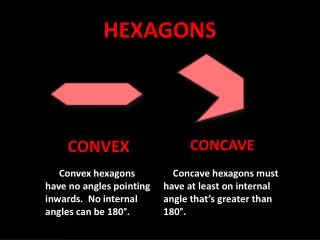
Hexagons can be classified into two distinct types: convex and concave. Convex hexagons have no angles pointing inwards; all internal angles are less than 180°. In contrast, concave hexagons have at least one internal angle exceeding 180°, creating an inward indentation. This fundamental distinction affects their geometric properties and applications. Understanding these characteristics is essential for anyone studying geometry or working with polygon shapes.
Download
1 / 2
Download Presentation 
Understanding Concave and Convex Hexagons: Key Differences and Properties
An Image/Link below is provided (as is) to download presentation
Download Policy: Content on the Website is provided to you AS IS for your information and personal use and may not be sold / licensed / shared on other websites without getting consent from its author.
Content is provided to you AS IS for your information and personal use only.
Download presentation by click this link.
While downloading, if for some reason you are not able to download a presentation, the publisher may have deleted the file from their server.
During download, if you can't get a presentation, the file might be deleted by the publisher.
E N D
Presentation Transcript
HEXAGONS CONCAVE CONVEX Convex hexagons have no angles pointing inwards. No internal angles can be 180°. Concave hexagons must have at least on internal angle that’s greater than 180°.

More Related