Understanding Continental Drift: The Movement of Earth's Landmasses Through Time
This educational overview explores the theory of continental drift, initially proposed by Alfred Wegener in 1912. It delves into the evidence supporting this theory, highlighting how continents like South America and Africa appear to fit together like a puzzle. It examines various proofs, including fossil similarities, glacial grooves in India, GPS tracking of tectonic plates, and the alignment of mountain ranges. Understanding these geological shifts provides insight into Earth's past and its evolving geography over millions of years.

Understanding Continental Drift: The Movement of Earth's Landmasses Through Time
E N D
Presentation Transcript
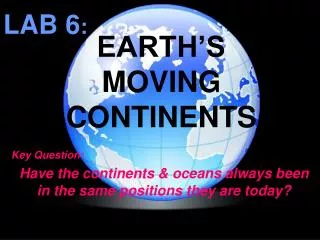
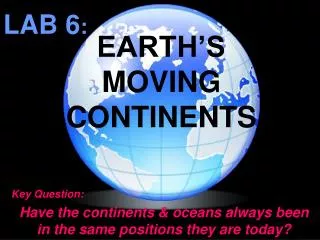
LAB 6: EARTH’S MOVING CONTINENTS Key Question: Have the continents & oceans always been in the same positions they are today?
1. Alfred Wegener – Proposed the theory of continental drift (1912)
Evidence Supporting CONTINENTAL DRIFT THEORY and that PANGEAonce existed
(1) The continents, especially South America and Africa seem to FIT TOGETHER LIKE A PUZZLE
(2) PLANT & ANIMAL FOSSILS were very similar, yet they were found on different continents
(3) GLACIAL GROOVES in India indicate that the subcontinent must have been in a different location than it is today
(5) There are SIMILAR ROCK TYPES on opposite sides of the Altlantic Ocean
(6) Today, theMODERN (insect-eating) MAMMALSon each continent are similar & distantly related
(7) There are SUTURE ZONES(areas where 2 continents come together to form 1 continent)…mountains form
(8) MOUNTAIN RANGES LINE UP when the continents are moved together
53. Pangea – A supercontinent from 250 m.y.a. that included all the Earth’s continental crust • Alfred Wegener – Proposed the theory of continental drift (1912) 13. Continental Drift Theory – Theory that the continents were in one position, have moved and continue to move
16. Glacial Grooves – Evidence of glacial movement on land 18. Glaciers – Large mass of ice formed on land that flows down or out due to its own weight 48. Suture Zones – Areas where two continents come together to form one continent at continent-continent collision zones