The Spirit of the West: Exploring Westward Expansion and Its Impact
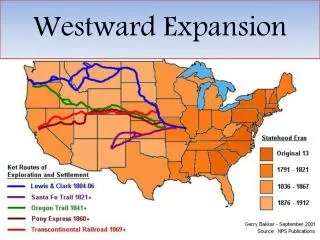
The American West represents both a land of opportunity and a complex history of conflict. This overview examines the concept of the frontier and manifest destiny, revealing the diverse landscapes, from the Great Plains to the Rocky Mountains. It highlights the intertwining stories of fur traders, miners, ranchers, and American Indians, detailing the rise of boomtowns and the struggles for statehood. The impact of the Homestead Act and the Dawes Act on both settlers and Indigenous peoples reflects the tension of this transformative era, shaping the nation's identity.

The Spirit of the West: Exploring Westward Expansion and Its Impact
E N D
Presentation Transcript
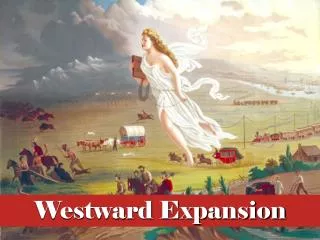
Spirit of the West • What is the West? • What is the Frontier? • An idea of manifest destiny. It was there to conquer. • Possibilities of a new beginning, fresh start
Barriers • Great American Desert • Great Plains • Rocky Mountains • Arid Southwest • Under 10 inches of rainfall • Animals • Millions of buffalo • American Indian • Most successful
Stages of Development • Fur Traders • In advance of civilization • Prepared way for others • Mining • Often first on the scene
Boomtowns • Henry Comstock staked claim near Virginia City. Could not find any gold and sold his claim, not realizing that the soil was almost pure silver. • Boomtowns • quickly growing towns that arise nearly overnight. • Vigilance committees – self appointed • Vigilante justice
Statehood Mining led to statehood. The development of California, Colorado, Arizona, the Dakotas, and Montana. The rail roads helped bring people.
Types of Mining • Placer mining: picks, shovels, and pans. • Sluices • Hydraulic mining • Come in after placer miners left • Professional
Ranching • Long Horn • Adapted to Texas • Ranching begins • Open range • Long Drive • To MO, KS, NE, WY • Most cattle ended up in Chicago
Cattle Kingdoms • Land was Free • Homestead Act only applied to surveyed land • Hope for sudden wealth • Cowboy traditions and rules • Round up, branding, line-riding • Became big business • Investors from overseas and eastern US
Problems in Cattle Country • Overstocking • By stock companies from East and Overseas • Barbed Wire • Closed the trails • Range wars • Ended open-range • Bad years 85-87 • Dry summers and the worst blizzards • Thousands of cattle died
Settling the Plains • Major Stephen Long • Explored plains “almost wholly unfit for cultivation.” • Homestead Act • $10 fee – 160 acre plots (homestead) • With the assurance of land many will flock to the plains.
Farming the Plains • Dry-Farming • Plant deep • Plows, sod drills • Sod Busters • Plow, wind erosion, drought • Lost homestead
Wheat Belt • Big business • Bonanza Farms 50,000 acres • Biggest wheat exporter • Farm hit hard times • Drought • Mortgage land • Tenement farms
Closing the Frontier • 1889 last territory for settlement • Frederick Jackson Turner • “Safety Valve” a place for people to get a fresh start – the social discontent.
The Indian Barrier • Plains Indians • Nomadic people – follow buffalo • Physically finest in west • Skilled Horsemen (20 arrows to one rifle shot) • Fighting for way of life
Sioux Uprising • 1862 Minnesota – the Dakota Sioux agreed to live on reservations in exchange for annuities (annual payments from government) • The payments rarely got to the Sioux • Poverty and starvation was a real possibility • After the rebellion was suppressed • 308 sentenced to death • Reduced to 38 by Lincoln
Sand Creek • Cheyenne-Arapaho • Led by Chief Black Kettle • Raided settlers • Told to Surrender at Ft. Lyon • Black Kettle wanted to negotiate peace • Retreated to Sand Creek • Col. Chivington attacked and killed ½ the tribe
Plan for Peace • Indian Peace Commission • Create 2 Large Reservations • Keep Indians separated from Settlers • Doomed from the beginning • faced poverty, starvation, and corruption on reservations • Settlers and Indians both violated treaties
Little Bighorn • Black Hills opened for mining • Last straw for Sioux • Chief Sitting Bull • Amassed warriors at Little Bighorn River • Col. George Custer • Attacked without orders • 265 men stumbled into 3000 Sioux warriors • Custer was seen as a hero
Fight of Nez Perce • Chief Joseph • Refused to move to a smaller reservation • Led 700 people 1,600 miles • 100 warriors defeated 10 units • 4 months on the run • Caught 40 miles from Canada • Ordered to move to reservation
Wounded Knee • Ghost Dance • A ritual to bring back buffalo and make whites disappear • Was banned by Government for fear of violence • Federal Troops killed c.200 Lakota
Dawes Act • 160 acre plots • Head of household • In trust for 25 years • Become citizens in 25 years • Rest of reservation land to be sold to settlers and put in a trust for American Indians • Goal • Assimilate • Indian Schools to “civilize”
Failure • Did not change anything • Most did not have the Knowledge • Many had no desire • in the end buffalo did more to change American Indians than policy.