Download
1 / 6
60 likes | 196 Views
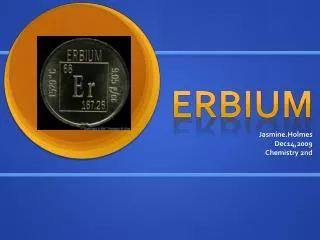
Erbium, a rare earth element, is known for its diverse applications and interesting properties. It is often added to other metals to reduce hardness and is widely used as a pink colorant in glass and porcelain glazes. This versatile element is also significant in the nuclear industry and photography due to its unique optical properties. With a boiling point of 2510°C and a density of 8.795 g/cm³, erbium is notable for its grayish coloration and hexagonal crystal structure. Discovered in 1842 by Gustav Mosander, erbium is sourced from minerals like monazite and bastnaesite.

E N D
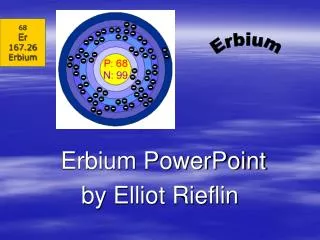
Erbium Erbium PowerPoint by Elliot Rieflin
Uses for Erbium • It may be added to other metals to lower hardness. • Erbium oxide is used as a pink colorant in glass • Erbium oxide is also used as a pink colorant in porcelain glaze • Nuclear industry • Photographic filter
Properties of Erbium • Boiling Point: 2510.0 °C (4550.0 °F) • density 8.795 g/cm3 • Color: grayish • Atomic Weight 167.26 • Crystal Structure: Hexagonal
Facts about Erbium • Named after the village of "Ytterby" near Vaxholm in Sweden • Klemm and Bommer- first to produce pure Erbium • Originally discovered by Gustav Mosander • Year of discovery 1842 • Interesting fact, cost when pure= 270 $ • It’s sources are the metals, Monazite, and bastnaesite
Bibliography • http://www.chemicalelements.com/index.html • http://chemistry.allinfoabout.com/periodic/periodictable.html • http://www.webelements.com/webelements/scholar/elements/periodic-table/uses.html • http://www.chemicool.com/ • http://chemistry.about.com/library/blper5.htm