PRISM AI Audit Framework
The PRISM AI Audit Framework is a practical guide created to help auditors, risk teams, and organizations review AI systems with confidence. This PDF explains how to assess AI using a clear, risk-based approach instead of complex theory. It covers the full AI lifecycle, including governance, risk management, data quality, model behavior, operations, and compliance. The framework aligns with major standards like the EU AI Act, ISO/IEC 42001, and NIST AI RMF. With step-by-step audit procedures, real evidence requirements, and ready-to-use templates, PRISM supports real-world AI audits across ind

PRISM AI Audit Framework
E N D
Presentation Transcript
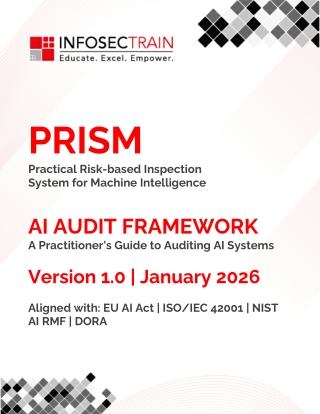
PRISM AI Audit Framework v1.0 PRISM Practical Risk-based Inspection System for Machine Intelligence AI AUDIT FRAMEWORK A Practitioner's Guide to Auditing AI Systems Version 1.0 | January 2026 Aligned with: EU AI Act | ISO/IEC 42001 | NIST AI RMF | DORA Page 1 | Confidential
PRISM AI Audit Framework v1.0 Contents Part 1: Framework Foundation…………………………………………………………………………………..3 1.1 What This Framework Is (and Isn't) ………………………………………………………………..………3 1.2 Audit Types and When to Use Them………………………………………………………………….……4 1.3 Risk-Based Audit Scoping………………………………………………………..…………………….……5 Part 2: The Six Audit Domains………………………………………………………..…………………….……6 Domain 1: Governance & Accountability………………………………………………………………….……7 Domain 2: Risk Management………………………………………………………………….……………..…10 Domain 3: Data Integrity……………………………………………………………………………..…….……12 Domain 4: Model Lifecycle………………………………………………………………………………………14 Domain 5: Operational Controls………………………………………………………………………..….……16 Domain 6: Compliance & Ethics……………………………………………………………………..…….……18 Part 3: Audit Execution…………………………………………………………………………………...….……20 3.1 Evidence Collection Techniques…………………………………………………………………...….……20 3.2 Testing Procedures…………………………………………………………………...….…………………..20 3.3 Finding Classification…………………………………………………………………...….………………...21 3.4 Reporting Standards…………………………………………………………………...….…….…………...22 Part 4: Workpaper Templates………………………………………………………………….…….…………...23 WP-01: Audit Planning Checklist……………………………………………………………..…….…………...23 WP-02: System Assessment Summary……………………………………………………...…….…………...23 WP-03: Control Testing Workpaper………………………………………………………………...…………...24 WP-04: Finding Documentation…………………………………………………………...….…….…………...24 WP-05: Interview Record…………………………………………………...……………...….…….…………...25 WP-06: Bias Testing Results……………………………………………………………....….…….…………...25 Quick Reference: PRISM Control Summary……………………..………………………….…….…………...26 Domain 1: Governance (8 controls) ……………………..…………………………...……….…….……….....26 Domain 2: Risk Management (10 controls) ……………………..……………………..…….…….…………..26 Domain 3: Data Integrity (12 controls) ……………………..…………………………..…….…….…………..26 Domain 4: Model Lifecycle (14 controls) ……………………..………………………..…….…….…………..27 Domain 5: Operational Controls (10 controls) ……………………..………………….…….…….…………..27 Domain 6: Compliance & Ethics (8 controls) …………………...……………………..…….…….…………..27 Page 2 | Confidential
PRISM AI Audit Framework v1.0 Part 1: Framework Foundation 1.1 What This Framework Is (and Isn't) PRISM is built for auditors who need to assess AI systems in real-world environments. It's not an academic exercise or a compliance checklist generator. What PRISM Is: • • • • A risk-based methodology for evaluating AI systems across their lifecycle Practical procedures that work whether you're auditing a startup's ML model or an enterprise AI platform Evidence-focused — every control has specific artifacts to collect and tests to perform Regulatory-aware — mapped to EU AI Act, ISO 42001, NIST AI RMF, but not dependent on any single standard Scalable — from a single high-risk model to an organization-wide AI audit • What PRISM Is Not: • • • • A certification scheme (though it supports ISO 42001 audits) A replacement for professional judgment — you still need to think A guarantee of AI safety — no audit framework can promise that An ethics evaluation tool — that requires different expertise The Core Premise AI audit is fundamentally different from traditional IT audit. Here's why: Traditional IT Audit AI Audit Deterministic systems — same input = same output Probabilistic systems — same input may yield different outputs Logic is learned from data (often opaque) Models drift continuously even without code changes Testing is statistical (accuracy, precision, recall) Logic is explicit in code Change control is event-based Testing is binary (pass/fail) Security = prevent unauthorized access Security = prevent unauthorized access + adversarial attacks + data poisoning Documentation must explain why system behaves as it does Documentation describes what system does This means auditors must adapt their techniques. PRISM provides that adaptation. Page 3 | Confidential
PRISM AI Audit Framework v1.0 1.2 Audit Types and When to Use Them Audit Type Purpose Typical Scope Duration Output Single AI system 1-2 weeks Pre-Deployment Review Operational Audit Assess readiness before go-live Go/No-Go recommendation with conditions 2-4 weeks Evaluate controls on live systems Single system or portfolio All in-scope systems Findings report with remediation plan Compliance Audit 4-8 weeks Verify regulatory conformity Compliance status + gap analysis Incident Investigation Affected system(s) 1-3 weeks Root cause analysis post-incident Incident report + recommendations 2-3 weeks Third-Party Assessment Certification Audit Evaluate vendor AI systems ISO 42001 or equivalentOrganization-wide Vendor product/service Risk assessment + contract recommendations Certification recommendation 6-12 weeks AIMS Selecting the Right Audit Type Decision matrix for audit type selection: Trigger Recommended Audit Type Minimum Scope New AI system ready for deployment Annual audit cycle EU AI Act compliance deadline AI system produced harmful output New AI vendor under consideration ISO 42001 certification required Board/regulator request Pre-Deployment Review Operational Audit Compliance Audit Incident Investigation Third-Party Assessment Certification Audit Depends on request All Domain 3 + 4 controls Risk-based selection of systems All high-risk AI systems Affected system + related systems Vendor's AI offering Full AIMS scope As specified Page 4 | Confidential
PRISM AI Audit Framework v1.0 1.3 Risk-Based Audit Scoping Not all AI systems require the same audit intensity. PRISM uses a risk-based approach to determine audit depth. Step 1: System Risk Classification Use this matrix to classify each AI system: Risk Factor Low (1) Medium (2) High (3) Weight Decision Impact Informational only 25% Influences human decisions Internal business data Autonomous decisions affecting people Personal/sensitive data Data Sensitivity 20% Public/aggregated data Internal users only Easily reversible Affected Population Reversibility Limited external users Reversible with effort Large public population 20% 15% Irreversible or high-cost reversal AI-specific regulations apply Regulatory Scope Not regulated General regulations apply 20% Weighted Risk Score = Σ (Factor Score × Weight) Score Range Risk Level Audit Intensity Control Coverage 2.5 - 3.0 2.0 - 2.4 Critical High Full audit — all controls tested 100% of PRISM controls All controls, sampling for operational Comprehensive audit — key controls tested in depth Focused audit — risk areas prioritizedGovernance + highest-risk domains Limited review — spot checks only 1.5 - 1.9 1.0 - 1.4 Medium Low Governance + data controls only Step 2: Determine Sample Size For organizations with multiple AI systems: Population Size Critical Risk High Risk Medium Risk Low Risk 1-5 systems 6-15 systems 16-50 systems 51-100 systems 100+ systems 100% 100% 100% 100% 100% 100% 100% 70% 50% 30% 100% 60% 40% 25% 15% 50% 30% 20% 10% 5% Note: All Critical risk systems must be audited regardless of population size. Page 5 | Confidential
PRISM AI Audit Framework v1.0 Part 2: The Six Audit Domains PRISM organizes AI audit into six domains. Each domain contains control objectives, specific audit procedures, evidence requirements, and testing techniques. Domain Focus Area Key Question # Controls 1. Governance 8 Is there clear ownership and policy? Who is accountable? What are the rules? 10 Are AI-specific risks identified and treated? 2. Risk Management 3. Data Integrity 4. Model Lifecycle What can go wrong? How is it managed? Is the data trustworthy? 12 14 Can we trust what the model learned from? Is the model reliable and well-documented? Is the model built and maintained properly? Is the system running safely? 10 Is the system monitored and protected? 5. Operational Controls Are we meeting obligations? 8 Are regulatory and ethical requirements met? 6. Compliance & Ethics Page 6 | Confidential
PRISM AI Audit Framework v1.0 DOMAIN 1: GOVERNANCE & ACCOUNTABILITY This domain assesses whether the organization has established clear ownership, policies, and structures for AI governance. Without this foundation, technical controls are meaningless. Control Objectives ID Control Objective Risk Addressed G-01 Unclear rules lead to inconsistent practices AI governance policy is documented, approved, and communicated Roles and responsibilities for AI are defined and assigned G-02 G-03 No accountability = no ownership of problems Decisions made without proper oversight AI governance committee/function exists with appropriate authority AI system inventory is complete and current AI strategy aligns with organizational risk appetite G-04 G-05 Unknown systems = unmanaged risk AI investments misaligned with business tolerance Under-resourced governance fails Unqualified personnel making AI decisions Strategic risks not visible to leadership G-06 G-07 G-08 Resource allocation for AI governance is adequate AI competency requirements are defined and training provided Board/executive oversight of AI is established Audit Procedures G-01: AI Governance Policy Evidence to collect: • • • • AI governance policy document Policy approval records (board minutes, sign-off) Communication records (emails, intranet announcements, training materials) Policy acknowledgment records from staff Tests to perform: 1. Verify policy exists and has been approved within the last 24 months 2. Check policy covers: scope definition, risk classification, approval requirements, roles, prohibited uses 3. Interview 3-5 staff in different roles — ask them to describe AI policy requirements 4. Verify policy is accessible (not buried in SharePoint) 5. Check policy references current regulations (EU AI Act, applicable standards) Red flags: • • • Policy hasn't been updated since before EU AI Act (pre-2024) Staff cannot articulate basic policy requirements Policy exists but no evidence of enforcement G-02: Roles and Responsibilities Evidence to collect: Page 7 | Confidential
PRISM AI Audit Framework v1.0 • • • • Organization chart showing AI governance roles Job descriptions for AI-related positions RACI matrix for AI activities System ownership register Tests to perform: 6. For 5 AI systems in inventory, verify each has a named business owner and technical owner 7. Interview owners — confirm they understand their responsibilities 8. Check for segregation of duties (developer ≠ approver ≠ deployer) 9. Verify escalation paths are documented and known Red flags: • • • Systems with no assigned owner Owners unaware of their accountability Same person develops, tests, and approves AI systems Page 8 | Confidential
PRISM AI Audit Framework v1.0 G-03: Governance Committee/Function Evidence to collect: • • • • Committee charter/terms of reference Meeting minutes from last 12 months Membership list with roles Decision log Tests to perform: 10. Verify committee meets at required frequency (at least quarterly for high-risk) 11. Review 3-5 meeting minutes — check for substantive discussion, decisions, action items 12. Confirm committee has authority to approve/reject AI deployments 13. Check membership includes appropriate expertise (technical, legal, business, ethics) 14. Verify committee reviews high-risk AI before deployment Red flags: • • • • Committee exists on paper but doesn't meet Meetings are rubber-stamp exercises with no real discussion No technical expertise on committee High-risk AI deployed without committee review G-04: AI System Inventory Evidence to collect: AI system inventory/register Inventory update procedures Last inventory reconciliation • • • Tests to perform: 15. Obtain current inventory — check completeness of required fields 16. Select 5 systems from inventory — verify they exist and details are accurate 17. Identify 3 AI use cases through interviews/observation — verify they're in inventory 18. Check procurement records for AI purchases — verify all appear in inventory 19. Review cloud billing for ML services (SageMaker, Azure ML, etc.) — cross-reference with inventory Red flags: • • • • Inventory hasn't been updated in >6 months Systems found in production that aren't in inventory ChatGPT/Copilot usage not tracked No process to add new systems to inventory Page 9 | Confidential
PRISM AI Audit Framework v1.0 DOMAIN 2: RISK MANAGEMENT This domain assesses whether AI-specific risks are systematically identified, assessed, treated, and monitored. Generic enterprise risk management is insufficient for AI. Control Objectives ID Control Objective Risk Addressed R-01 R-02 AI risk assessment methodology is defined and applied AI systems are classified by risk level Ad-hoc risk identification misses critical risks All systems treated equally = over/under governance Risks identified but not addressed Discrimination risk not evaluated Vendor AI creates unmanaged exposure Human rights violations Unacknowledged risk exposure No visibility into aggregate AI risk New threats not identified Stale assessments don't reflect current state R-03 R-04 R-05 R-06 R-07 R-08 R-09 R-10 Risk treatment plans exist for identified risks Bias and fairness risks are specifically assessed Third-party AI risks are evaluated Fundamental rights impact is assessed for high-risk AI Residual risk is formally accepted by appropriate authority Risk register is maintained and current Emerging AI risks are monitored Risk assessments are periodically refreshed Audit Procedures R-01: Risk Assessment Methodology Evidence to collect: • • • AI risk assessment procedure/methodology document Risk assessment templates Completed risk assessments (sample of 5) Tests to perform: 20. Verify methodology addresses AI-specific risks (bias, drift, adversarial attacks, opacity) 21. Check methodology considers: impact, likelihood, data sensitivity, autonomy level 22. Review 5 completed assessments — verify methodology was actually followed 23. Interview assessors — confirm they understand and can apply the methodology 24. Verify assessments are performed before deployment (not after) Red flags: • • • • Using generic IT risk methodology without AI adaptations Risk assessments completed post-deployment Assessments don't consider bias, fairness, or explainability Copy-paste assessments with no system-specific analysis Page 10 | Confidential
PRISM AI Audit Framework v1.0 R-04: Bias and Fairness Assessment Evidence to collect: • • • • Bias testing methodology/procedure Bias test results for high-risk systems Fairness metrics definitions Mitigation actions taken Tests to perform: 25. Verify bias testing is required for all Tier 1/2 systems 26. Review bias test results for 3 high-risk systems 27. Check protected characteristics tested (gender, age, race, disability, etc.) 28. Verify fairness metrics are appropriate for use case (demographic parity, equalized odds, etc.) 29. Confirm mitigation actions were implemented where bias detected 30. Check ongoing bias monitoring is in place (not just pre-deployment testing) Red flags: • • • • No bias testing performed on decision-making systems Testing done on training data only, not production data Bias detected but no remediation Fairness metrics not defined or inappropriate for use case Page 11 | Confidential
PRISM AI Audit Framework v1.0 DOMAIN 3: DATA INTEGRITY This domain assesses whether the data used to train and operate AI systems is trustworthy. Garbage in = garbage out. This is often the highest-risk area. Control Objectives ID Control Objective Risk Addressed D-01 D-02 D-03 D-04 D-05 D-06 D-07 D-08 D-09 D-10 D-11 D-12 Training data sources are documented and validated Data quality standards are defined and enforced Data lineage is tracked from source to model Personal data processing has legal basis Consent management is implemented where required Data labeling quality is assured Data version control is maintained Synthetic/augmented data use is controlled Data retention and deletion policies are enforced Data access controls are implemented Data drift is monitored Data documentation (data sheets) is maintained Model trained on inappropriate/biased data Low-quality data degrades model performance Cannot trace decisions back to data Privacy violations, regulatory breach Using data without proper consent Incorrect labels = incorrect learning Cannot reproduce training conditions Synthetic data introduces artifacts Retaining data beyond legal limits Unauthorized access to training data Production data differs from training data No understanding of data characteristics Audit Procedures D-01: Training Data Validation Evidence to collect: • • • • Data source documentation Data acquisition agreements/licenses Data validation reports Data sheet (if available) Tests to perform: 31. For 3 high-risk models, trace training data back to original sources 32. Verify data sources are appropriate for the use case (representative, relevant) 33. Check for proper licensing/permission to use data for ML training 34. Review data validation checks performed before training 35. Verify no prohibited data sources (e.g., scraped without permission, biased historical data) Red flags: • • • • Training data sources unknown or undocumented Using publicly scraped data without license verification Historical data with known biases used without correction No validation performed on training data quality Page 12 | Confidential
PRISM AI Audit Framework v1.0 D-06: Data Labeling Quality Evidence to collect: • • • • Labeling procedures/guidelines Labeler qualifications/training records Inter-annotator agreement metrics Label quality review results Tests to perform: 36. Review labeling guidelines — check for clarity and completeness 37. Verify labelers were qualified and trained for the task 38. Check inter-annotator agreement scores (should be >80% for most tasks) 39. Review sample of labels for accuracy (request 50 samples with ground truth) 40. Verify label disputes were resolved with documented process Red flags: • • • • Labels created by unqualified/untrained personnel No inter-annotator agreement measured Single labeler with no quality review Labeling guidelines vague or nonexistent Page 13 | Confidential
PRISM AI Audit Framework v1.0 DOMAIN 4: MODEL LIFECYCLE This domain assesses whether AI models are developed, tested, deployed, and maintained with appropriate rigor. This is the technical heart of AI audit. Control Objectives ID Control Objective Risk Addressed M-01 M-02 M-03 M-04 M-05 M-06 M-07 M-08 M-09 M-10 M-11 M-12 M-13 M-14 Model development follows documented methodology Model requirements are defined and traceable Model architecture decisions are documented and justifiedInappropriate model for problem Model training is reproducible Model testing is comprehensive and documented Model validation is independent from development Model performance metrics are defined and measured Model explainability is assessed and documented Model versioning and change control is implemented Model deployment follows defined process Model documentation (model cards) is maintained Model retraining triggers and procedures are defined Model decommissioning process exists Transfer learning and foundation models are controlled Inconsistent, unreproducible development Model doesn't meet business needs Cannot recreate or validate model Untested failure modes Developer blind spots not caught No objective measure of quality Black box decisions Lost track of which model is in production Ad-hoc deployments bypass controls No understanding of model behavior Model degrades without update Obsolete models remain in use Inheriting unknown biases/risks Audit Procedures M-05: Model Testing Evidence to collect: • • • • • Test strategy/plan documents Test case documentation Test execution results Test data documentation Edge case and failure mode testing results Tests to perform: 41. Review test strategy — verify it covers: functional, performance, bias, adversarial, edge cases 42. Check test data is representative and separate from training data 43. Review test results — verify pass/fail criteria were defined in advance 44. Confirm negative testing performed (what happens with bad inputs?) 45. Verify testing includes real-world scenarios, not just clean lab data 46. Check for adversarial testing (attempts to fool the model) Red flags: • • Testing only on same data distribution as training No edge case or failure mode testing Page 14 | Confidential
PRISM AI Audit Framework v1.0 • • Pass/fail criteria defined after seeing results No adversarial testing on security-relevant systems M-08: Model Explainability Evidence to collect: • • • • Explainability requirements for system Explainability method documentation Sample explanations generated User comprehension testing results Tests to perform: 47. Verify explainability requirements are defined based on use case and risk level 48. Review explainability method used (SHAP, LIME, attention weights, etc.) 49. Request explanation for 5 sample predictions — assess quality and usefulness 50. For high-risk systems, verify explanations are understandable to affected individuals 51. Check explanations are logged and available for audit/appeal Red flags: • • • • High-risk decisions with no explanation capability Explanations are technical jargon incomprehensible to users Explanations not logged or available after the fact Using opaque model where explainability is legally required Page 15 | Confidential
PRISM AI Audit Framework v1.0 DOMAIN 5: OPERATIONAL CONTROLS This domain assesses whether AI systems are securely operated, monitored, and protected in production. Where things actually go wrong. Control Objectives ID Control Objective Risk Addressed O-01 O-02 O-03 O-04 O-05 Human oversight mechanisms are implemented Performance monitoring is continuous Model drift detection is implemented Anomaly detection identifies unusual behavior Autonomous harmful decisions Degradation not detected Model becomes inaccurate over time Attacks or failures not detected Unprepared for AI failures Incident response procedures include AI-specific scenarios Business continuity plans address AI dependencies Security controls protect against adversarial attacks Access controls limit who can modify AI systems Audit logging captures AI decisions and changes Fallback mechanisms exist for AI failure O-06 O-07 O-08 O-09 O-10 AI failure disrupts operations Model manipulation Unauthorized changes No evidence trail No alternative when AI fails Audit Procedures O-01: Human Oversight Evidence to collect: • • • • Human oversight design documentation Override mechanism documentation Override usage logs Escalation procedures Tests to perform: 52. For high-risk systems, verify human oversight model is defined (in-the-loop, on-the-loop, over-the-loop) 53. Test override mechanism — can a human actually stop/reverse a decision? 54. Review override logs — are overrides happening? Too many = system unreliable. Zero = rubber stamp? 55. Interview human reviewers — do they understand when to override? Are they empowered to do so? 56. Check response time — can humans intervene before harm occurs? Red flags: • • • • No override mechanism for consequential decisions Override exists but never used (suggests reviewers are rubber-stamping) Humans cannot intervene in real-time for time-critical decisions Reviewers not trained on when/how to override Page 16 | Confidential
PRISM AI Audit Framework v1.0 O-03: Model Drift Detection Evidence to collect: • • • • Drift detection methodology Drift monitoring dashboards/reports Drift alert configurations Retraining trigger criteria Tests to perform: 57. Verify drift monitoring is implemented for all production models 58. Review drift metrics tracked (data drift, concept drift, prediction drift) 59. Check alert thresholds are defined and appropriate 60. Review drift alerts from past 6 months — verify they were investigated and resolved 61. Confirm retraining is triggered when drift exceeds thresholds Red flags: • • • • No drift monitoring on production models Alerts configured but no one reviewing them Model in production >12 months with no drift analysis Drift detected but model not retrained Page 17 | Confidential
PRISM AI Audit Framework v1.0 DOMAIN 6: COMPLIANCE & ETHICS This domain assesses whether regulatory and ethical obligations are met. The most consequential domain for avoiding fines and reputational damage. Control Objectives ID Control Objective Risk Addressed C-01 C-02 C-03 C-04 C-05 C-06 C-07 C-08 Regulatory requirements are identified and tracked Conformity assessments are completed for high-risk AI Transparency obligations are met Technical documentation meets regulatory requirements Incident reporting procedures meet regulatory timelines AI ethics principles are defined and operationalized Prohibited AI uses are identified and prevented Records are maintained for regulatory demonstration Non-compliance with applicable laws EU AI Act non-compliance User deception, regulatory breach Insufficient evidence for compliance Late or missed notifications Ethical violations Deploying banned AI systems Cannot prove compliance Audit Procedures C-02: Conformity Assessment (EU AI Act) Evidence to collect: • • • • • • High-risk AI classification documentation Conformity assessment reports Technical documentation per Annex IV Quality management system documentation CE marking records EU database registration Tests to perform: 62. Identify all AI systems that may fall under Annex III high-risk categories 63. Verify conformity assessment was performed (internal or notified body as required) 64. Review technical documentation against Annex IV requirements 65. Check quality management system addresses EU AI Act requirements 66. Verify CE marking applied correctly 67. Confirm registration in EU database for applicable systems Red flags: • • • • High-risk systems deployed without conformity assessment Technical documentation doesn't meet Annex IV requirements No quality management system for AI Systems not registered in EU database when required Page 18 | Confidential
PRISM AI Audit Framework v1.0 C-03: Transparency Obligations Evidence to collect: • • • • User notification mechanisms (chatbot disclosures, etc.) Transparency documentation for affected individuals Explanation provision mechanisms Deepfake/synthetic content labeling Tests to perform: 68. For chatbots/virtual assistants: verify users are informed they're interacting with AI 69. For emotion recognition systems: verify users are informed 70. For synthetic content generation: verify outputs are labeled as AI-generated 71. For high-risk systems: verify affected individuals can request explanations 72. Test user interfaces — is disclosure clear and prominent? Red flags: • • • • Chatbots pretending to be human Synthetic content not labeled No mechanism for affected individuals to request explanations Transparency notices buried in fine print Page 19 | Confidential
PRISM AI Audit Framework v1.0 Part 3: Audit Execution 3.1 Evidence Collection Techniques Technique When to Use Strength Limitation Document Review Efficient, comprehensive May not reflect actual practice Policy, procedure, documentation assessment Interview Subjective, may be rehearsed Understanding processes, culture, awareness Reveals nuance and context Shows actual practice Observation Hawthorne effect, point-in-time Process execution, control operation End-to-end process understanding Walkthrough Time-consuming, may be scripted Identifies gaps and handoffs Re-performance Testing control effectiveness Sample may not be representative Direct evidence of operation Objective, comprehensive Data Analysis Technical Testing Large-scale pattern detection Requires technical capability Requires specialized skills Security, performance, bias assessment Configuration, code, model review Definitive technical evidence Direct verification System Inspection Point-in-time, requires access 3.2 AI-Specific Testing Procedures Beyond traditional audit techniques, AI audit requires specialized testing: Bias Testing Test Type Description Tools/Methods Demographic Parity Equal positive prediction rates across groups Compare prediction rates by protected attribute Confusion matrices by group Distance metrics on feature space Reliability diagrams by group Calculate selection rate ratios Equalized Odds Individual Fairness Calibration Disparate Impact Equal true positive and false positive rates Similar individuals receive similar predictions Predictions are well-calibrated across groups Selection rates across groups (80% rule) Robustness Testing Test Type Description Tools/Methods Adversarial Inputs Out-of-Distribution Model behavior with malicious inputs Model behavior on unusual inputs FGSM, PGD, C&W attacks Generate OOD samples, measure confidence Systematic boundary exploration Load testing with concurrent requests Automated fuzz testing Boundary Testing Stress Testing Input Fuzzing Behavior at decision boundaries Performance under load Random/malformed input handling Page 20 | Confidential
PRISM AI Audit Framework v1.0 Performance Testing Metric Definition Acceptable Range (typical) Accuracy Precision Recall F1 Score AUC-ROC Latency Throughput Correct predictions / total predictions True positives / predicted positives True positives / actual positives Harmonic mean of precision and recall Area under ROC curve Response time Predictions per second >90% (varies by use case) >85% for high-stakes >85% for critical safety >80% >0.85 <100ms for real-time Depends on requirements 3.3 Finding Classification Findings must be classified consistently to enable prioritization and tracking: Severity Definition Examples Remediation Timeline Critical Immediate (stop activity) Immediate risk of significant harm; regulatory breach; fundamental control failure High-risk AI deployed without assessment; bias causing discrimination; no human oversight on autonomous decisions High 30 days Significant control weakness; likely regulatory finding; material risk exposure Incomplete risk assessments; no drift monitoring; inadequate documentation Medium 90 days Control gap that could lead to issues; best practice deviation Policy not updated; training gaps; incomplete testing Low 180 days Minor weakness; improvement opportunity; efficiency gain Documentation formatting; process optimization Observation Industry practices; emerging guidance Optional Not a deficiency; suggestion for enhancement Finding Documentation Requirements Each finding must include: • • • • • • • • • • • • Finding ID: Unique identifier Title: Brief descriptive title Domain: Which PRISM domain (G, R, D, M, O, C) Control Reference: Specific control objective Severity: Critical/High/Medium/Low/Observation Condition: What was found (factual description) Criteria: What should be in place (policy, standard, regulation) Cause: Why the gap exists (root cause) Effect: What could go wrong (risk/impact) Recommendation: What to do about it Management Response: Owner, action plan, target date Evidence Reference: Workpaper reference Page 21 | Confidential
PRISM AI Audit Framework v1.0 3.4 Reporting Standards Executive Summary Structure Every AI audit report should begin with a 1-2 page executive summary: • • • • • • Audit Scope: What was audited, what was excluded Overall Assessment: Summary opinion/rating Key Findings: Top 3-5 most significant findings Immediate Actions Required: Critical items needing immediate attention Positive Observations: What's working well Next Steps: Recommended follow-up activities Rating Scale Rating Definition Criteria Effective No Critical/High findings; <3 Medium findings Controls are well-designed and operating effectively Controls exist but have gaps Needs Improvement No Critical; ≤2 High findings; any number of Medium Any Critical finding OR >2 High findings Access limitations, scope exclusions Ineffective Not Assessed Significant control weaknesses Insufficient evidence to conclude Report Distribution Audience Content Format Board/Audit Committee 1-2 pages, high-level Executive summary, overall rating, critical findings only Executive Management 5-10 pages Executive summary + all High/Critical findings + trends Full report with all findings Findings relevant to their systems As specified by regulation AI Governance Committee System Owners Regulators (if required) Complete report Extracted findings Per regulatory format Page 22 | Confidential
PRISM AI Audit Framework v1.0 Part 4: Workpaper Templates The following templates support PRISM audit execution. Adapt as needed for your organization. WP-01: Audit Planning Checklist # Planning Step Completed Notes 1 Obtain AI system inventory from management ☐ 2 Classify systems by risk level ☐ 3 Determine sample size based on risk ☐ 4 Review prior audit findings and status ☐ 5 Identify regulatory requirements applicable ☐ 6 Request preliminary documentation ☐ 7 Schedule interviews with key personnel ☐ 8 Arrange system access for testing ☐ 9 Confirm audit timeline and milestones ☐ 10 Communicate audit scope to stakeholders ☐ WP-02: System Assessment Summary Field Response System Name System ID Business Owner Technical Owner System Description AI/ML Technology Risk Classification Regulatory Scope Data Types Processed ☐ Critical ☐ H i gh ☐ M edi um ☐ Low ☐ EU AI Act High-Risk ☐ D O R A ☐ Other: _______ Decision Impact Human Oversight Model Last Assessment Date ☐ In-the-loop ☐ O n-the-loop ☐ O ver -the-loop ☐ N one Key Concerns Identified Page 23 | Confidential
PRISM AI Audit Framework v1.0 WP-03: Control Testing Workpaper Field Response Control ID Control Objective System(s) Tested Test Procedure Performed Sample Size / Selection Method Evidence Reviewed Test Results Exceptions Noted Root Cause of Exceptions Control Assessment Finding Reference (if applicable) ☐ Effective ☐ Part i al l y Ef f ect i ve ☐ I nef f ect i ve Auditor Date Reviewer Review Date WP-04: Finding Documentation Field Response Finding ID Finding Title Domain Control Reference ☐ Governance ☐ R i sk ☐ D at a ☐ M odel ☐ O perat i ons ☐ C om pl i ance Severity Condition (What was found) ☐ Critical ☐ H i gh ☐ M edi um ☐ Low ☐ O bservat i on Criteria (What should be) Cause (Why the gap exists) Effect (Risk/Impact) Recommendation Evidence Reference Management Response Action Owner Target Remediation Date Auditor Date Page 24 | Confidential
PRISM AI Audit Framework v1.0 WP-05: Interview Record Field Response Interviewee Name Title/Role Date/Time Location/Format Interviewer(s) ☐ In-person ☐ Vi deo ☐ Phone Topics Covered Key Points Discussed Documents Provided/Promised Follow-up Items Interviewee Confirmation ☐ Notes shared ☐ C onf i rm ed accurat e ☐ C orrect i ons m ade WP-06: Bias Testing Results Field Response System Name Model Version Test Date Test Dataset Description Protected Attributes Tested Fairness Metrics Used Overall Accuracy Accuracy by Group Selection Rate by Group Disparate Impact Ratio Statistical Significance Bias Detected? Bias Description (if yes) ☐ Yes ☐ N o Mitigation Implemented Residual Bias Accepted? Tester ☐ Yes (by: _______) ☐ N o ☐ N/A Reviewer Page 25 | Confidential
PRISM AI Audit Framework v1.0 Quick Reference: PRISM Control Summary Complete list of all 62 control objectives for reference: Domain 1: Governance (8 controls) ID Control Objective G-01 G-02 G-03 G-04 G-05 G-06 G-07 G-08 AI governance policy is documented, approved, and communicated Roles and responsibilities for AI are defined and assigned AI governance committee/function exists with appropriate authority AI system inventory is complete and current AI strategy aligns with organizational risk appetite Resource allocation for AI governance is adequate AI competency requirements are defined and training provided Board/executive oversight of AI is established Domain 2: Risk Management (10 controls) ID Control Objective R-01 R-02 R-03 R-04 R-05 R-06 R-07 R-08 R-09 R-10 AI risk assessment methodology is defined and applied AI systems are classified by risk level Risk treatment plans exist for identified risks Bias and fairness risks are specifically assessed Third-party AI risks are evaluated Fundamental rights impact is assessed for high-risk AI Residual risk is formally accepted by appropriate authority Risk register is maintained and current Emerging AI risks are monitored Risk assessments are periodically refreshed Domain 3: Data Integrity (12 controls) ID Control Objective D-01 D-02 D-03 D-04 D-05 D-06 D-07 D-08 D-09 D-10 D-11 Training data sources are documented and validated Data quality standards are defined and enforced Data lineage is tracked from source to model Personal data processing has legal basis Consent management is implemented where required Data labeling quality is assured Data version control is maintained Synthetic/augmented data use is controlled Data retention and deletion policies are enforced Data access controls are implemented Data drift is monitored Page 26 | Confidential
PRISM AI Audit Framework v1.0 D-12 Data documentation (data sheets) is maintained Domain 4: Model Lifecycle (14 controls) ID Control Objective M-01 M-02 M-03 M-04 M-05 M-06 M-07 M-08 M-09 M-10 M-11 M-12 M-13 M-14 Model development follows documented methodology Model requirements are defined and traceable Model architecture decisions are documented and justified Model training is reproducible Model testing is comprehensive and documented Model validation is independent from development Model performance metrics are defined and measured Model explainability is assessed and documented Model versioning and change control is implemented Model deployment follows defined process Model documentation (model cards) is maintained Model retraining triggers and procedures are defined Model decommissioning process exists Transfer learning and foundation models are controlled Domain 5: Operational Controls (10 controls) ID Control Objective O-01 O-02 O-03 O-04 O-05 O-06 O-07 O-08 O-09 O-10 Human oversight mechanisms are implemented Performance monitoring is continuous Model drift detection is implemented Anomaly detection identifies unusual behavior Incident response procedures include AI-specific scenarios Business continuity plans address AI dependencies Security controls protect against adversarial attacks Access controls limit who can modify AI systems Audit logging captures AI decisions and changes Fallback mechanisms exist for AI failure Domain 6: Compliance & Ethics (8 controls) ID Control Objective C-01 C-02 C-03 C-04 C-05 Regulatory requirements are identified and tracked Conformity assessments are completed for high-risk AI Transparency obligations are met Technical documentation meets regulatory requirements Incident reporting procedures meet regulatory timelines Page 27 | Confidential
PRISM AI Audit Framework v1.0 C-06 C-07 C-08 AI ethics principles are defined and operationalized Prohibited AI uses are identified and prevented Records are maintained for regulatory demonstration — End of PRISM AI Audit Framework — Version 1.0 | For professional use | Adapt to organizational context Page 28 | Confidential