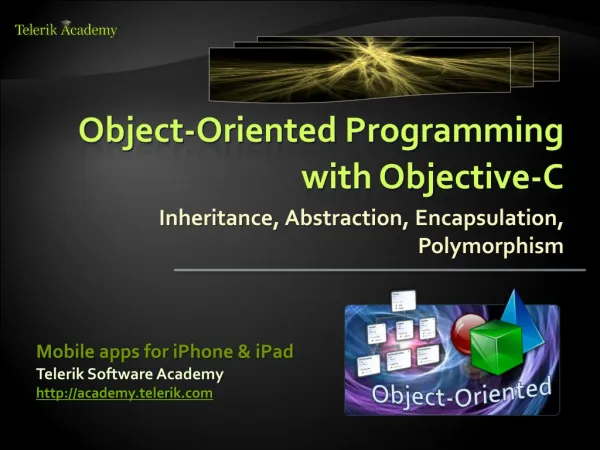
Mastering Object-Oriented Programming with Objective-C: Inheritance and Beyond
Dive into the essentials of Object-Oriented Programming (OOP) using Objective-C at Telerik Academy. This resource covers fundamental principles including Inheritance, Abstraction, Encapsulation, and Polymorphism, crucial for developing mobile applications for iPhone and iPad. Learn how to create classes, protocols, and leverage OOP concepts to enhance code reusability and extensibility. Practical examples illustrate how to define classes, inherit attributes, and implement methods effectively, making it easier to understand and apply OOP principles in your projects.

Mastering Object-Oriented Programming with Objective-C: Inheritance and Beyond
E N D
Presentation Transcript
Object-Oriented Programmingwith Objective-C Inheritance, Abstraction, Encapsulation, Polymorphism Telerik Software Academy http://academy.telerik.com Mobile apps for iPhone & iPad Object-Oriented
Table of Contents • OOP Principles • Inheritance • Protocols • Abstraction • Encapsulation
Fundamental Principles of OOP Object-Oriented
Fundamental Principles of OOP • Inheritance • Inherit members from parent class • Abstraction • Define and execute abstract actions • Encapsulation • Hide the internals of a class • Polymorphism • Access a class through its parent interface 4
Classes and Protocols • Classes define attributes and behavior • Fields, properties, methods, etc. • Methods contain code for execution • Protocols define a set of operations • Empty methods and properties, left to be implemented later @interface Shape: NSObject @end @implementation Shape @end @protocol Figure @end
Inheritance • Inheritance allows classes to inherit characteristics from an existing parent (super) class • Attributes (fields and properties) • Operations (methods) • A child class can extend the parent class • Add new fields and methods • Redefine methods (modify existing behavior) • A class can conform to a protocol by providing implementation for its methods 7
Types of Inheritance • Inheritance terminology base class / parent class derived class inherits class protocol conforms to 8
Inheritance – Benefits • Inheritance has a lot of benefits • Extensibility • Reusability (code reuse) • Provides abstraction • Eliminates redundant code • Use inheritance for buidling is-a relationships • E.g. person is-a mammal • Don't use it to build has-a relationship • E.g. person has-a name 9
Inheritance • Child classes implicitly gain all members from the super class • All fields, methods, properties • Some members are inaccessible (hidden) • The class whose methods are inherited is called base (parent) class • The class that gains new functionality is called derived (child) class
Inheritance – Example Base class Person +Name: NSString +Address: NSString Derived class Derived class Employee Student +Company: NSString +Salary: double +School: NSString
Class Hierarchies • Inheritance leads to a hierarchies of classes and / or protocols in an application: Game SinglePlayerGame MultiplePlayersGame Minesweeper … Solitaire BoardGame … Backgammon Chess 12
Inheritance in Objective-C • A class can inherit only one base class • E.g. NSMutableArray derives from NSArray • A class can conform to several protocols • This is Obj-C’s form of multiple inheritance • Shape conforms to Movable and Drawable 13
How to Define Inheritance? • Specify the name of the base class after the name of the derived (with colon) @interface Person: NSObject @property (strong, nonatomic) NSString* firstname; @property (strong, nonatomic) NSString* lastname; @end @interface Ninja: Person @property int rank; @end
How to Define Inheritance? • Specify the name of the base class after the name of the derived (with colon) @interface Person: NSObject @property (strong, nonatomic) NSString* firstname; @property (strong, nonatomic) NSString* lastname; @end @interface Ninja: Person @property int rank; @end Inherits properties firstnameand lastnamefrom Person
How to Define Inheritance? • Specify the name of the base class after the name of the derived (with colon) @interface Person: NSObject @property (strong, nonatomic) NSString* firstname; @property (strong, nonatomic) NSString* lastname; @end @interface Ninja: Person @property int rank; @end Inherits properties firstnameand lastnamefrom Person Adds new property
Simple Inheritance Example @interface Person: NSObject -(instancetype) initWithFirstname: (NSString *) fname andLastname: (NSString *) lname; -(void) introduce; -(void) walk; @end @implementation Person @synthesize firstname; @synthesize lastname; -(instancetype) initWithFirstname: (NSString *) fname andLastname: (NSString *) lname{ } -(void) introduce{ } -(void) walk{ } @end
Simple Inheritance Example @interface Ninja: Person @property int rank; -(instancetype) initWithRank: (int) rank; -(void) fight; @end @implementation Ninja @synthesize rank; -(instancetype) initWithRank: (int) rank{ self = [super initWithFirstname: @"[Unknown]" andLastname: @"[Unknown]"]; self.rank = rank; return self; } -(void) walk{ } -(void) fight{ } @end
Simple Inheritance Example Adds new property – rank @interface Ninja: Person @property int rank; -(instancetype) initWithRank: (int) rank; -(void) fight; @end Adds new method – fight @implementation Ninja @synthesize rank; -(instancetype) initWithRank: (int) rank{ self = [super initWithFirstname: @"[Unknown]" andLastname: @"[Unknown]"]; self.rank = rank; return self; } -(void) walk{ } -(void) fight{ } @end
Simple Inheritance Example Adds new property – rank @interface Ninja: Person @property int rank; -(instancetype) initWithRank: (int) rank; -(void) fight; @end Adds new method – fight @implementation Ninja @synthesize rank; -(instancetype) initWithRank: (int) rank{ self = [super initWithFirstname: @"[Unknown]" andLastname: @"[Unknown]"]; self.rank = rank; return self; } -(void) walk{ } -(void) fight{ } @end Overwrites the method from the parent
SimpleInheritance Live Demo
Inheritance: Important Aspects • In Objective-C there is no multiple inheritance • Yet, a class can conform to multiple protocols • Class members are also inherited • Init methods are inherited • Inheritance is transitive relation • If C is derived from B, and B is derived from A, then C inherits A as well
Inheritance: Important Features • When a derived class extends its base class • It can freely add new members • Cannot remove derived ones • Declaring new members with the same name or signature overwrites the inherited ones • A class may not provide implementation to some methods • Derived classes can provide the implementation
Abstraction • Abstraction means ignoring irrelevant features, properties, or functions and emphasizing the relevant ones ... • ... relevant to the given project • With an eye to future reuse in similar projects • Abstraction helps managing complexity "Relevant" to what? 25
Abstraction (2) • Abstraction is something we do every day • Looking at an object, we see those things about it that have meaning to us • We abstract the properties of the object, and keep only what we need • E.g. students get "name" but not "color of eyes" • Allows us to represent a complex reality in terms of a simplified model • Abstraction highlights the properties of an entity that we need and hides the others 26
Control +click() ButtonBase +Color : long CheckBox Button RadioButton Abstraction in .NET • In Objective-C object-oriented programming abstraction is achieved in several ways: • Protocols • Inheritance 27
Protocols • An protocol defines a set of messages (methods) that given object should perform • Also called "contract" for providing a set of operations • Defines abstract behavior • Protocols provide abstractions • You invoke the abstract actions • Without worrying how it is internally implemented 28
Protocols(2) • Protocols describe a prototype of group of methods (operations) or properties • Can be conformed by a given class • Define only the prototypes of the operations • No concrete implementation is provided • Can be used to define abstract data types • Can not be instantiated • Can contain optional and required members
Protocols – Example • @protocol Shape • @property double x; • @property double y; • -(void) moveToX:(double) x andY: (double)y; • -(double)calculateSurface; • -(double) calculateArea; • @end • @protocol Resizable • @property double width; • @property double height • -(void)resizeWidth: (double)width; • -(void)resizeHeight: (double)height; • -(void)resizeWidth: (double) width • andHeight: (double)weighty; • @end
Protocols Implementation • Classes can conform to one or several protocols • @interface Rectangle : NSObject<Shape> • -(instancetype) initWithX: (double) x • y: (double) y • width: (double) width • andHeight: (double) height; • @end; • Implementer classes must conform all methods and properties of the protocol
Interface Implementation (2) • @interface Rectangle: NSObjet<Shape, Resizable> • // Rectangle specific declarations @end • @implementation Rectangle • @synthesize x; @synthesize y; • @synthesize width; @synthesize height; • -(void) moveToX:(double) x • andY: (double)y { /* implementation */ } • -(double)calculateSurface { /* implementation */ } • -(double) calculateArea{ /* implementation */ } • -(void)resizeWidth: (int)width{ /* implementation */ } • -(void)resizeHeight: (int)height { /* implementation */ } • -(void)resizeWidth: (int) width • andHeight: (int)weighty { /* implementation */ } @end
Protocols andImplementations Live Demo
Encapsulation • Encapsulation hides the implementation details • Class announces some operations (methods) available for its clients – its public interface • All data members (fields) of a class should be hidden • Accessed via properties (read-only and read-write) • No interface members should be hidden 35
Encapsulation – Example • Data fields are private • Init methods and accessors are defined (getters and setters) Person -_name : NSString -_age : int +initWith: (NSString*) name andAge: (int) age +name : NString +age : int 36
Encapsulation in .NET • Fields are always declared private • They cannot be public anyway • Init methods are almost always declared public • Protocol members are always public • Non-interface members are declared private / protected 37
Encapsulation – Benefits • Ensures that structural changes remain local: • Changing the class internals does not affect any code outside of the class • Changing methods' implementation does not reflect the clients using them • Encapsulation allows adding some logic when accessing client's data • E.g. validation on modifying a property value • Hiding implementation details reduces complexity easier maintenance 38
Encapsulation Live Demo
Object-Oriented Programmingwith Objective-C http://academy.telerik.com
Homework • Implement classes for a simple Mortal Kombat game • Create characters that have name, set of skills, life and power • Different characters have different skills • Characters can punch, kick or use a skill • They cannot use a skill, if the power is not enough • Kicks and punches take damage and product power • Skills take damage and consume part of the power of the character
Homework (2) • (Cont.) Implement classes for a simple Mortal Kombatgame • Create 5 different characters with different skills • Use protocols and inheritance • Write a method to test the functionality • Use abstraction, encapsulation and polymorphism
Free Trainings @ Telerik Academy • C# Programming @ Telerik Academy • csharpfundamentals.telerik.com • Telerik Software Academy • academy.telerik.com • Telerik Academy @ Facebook • facebook.com/TelerikAcademy • Telerik Software Academy Forums • forums.academy.telerik.com