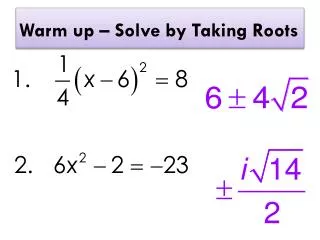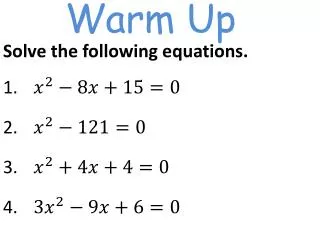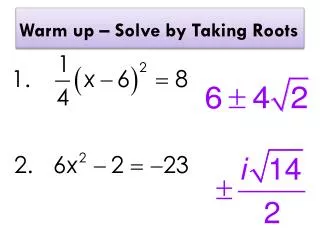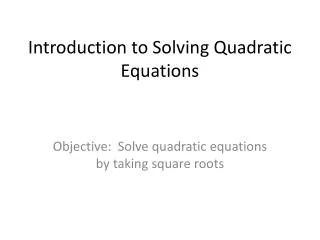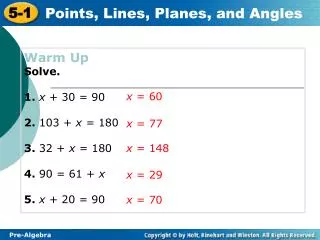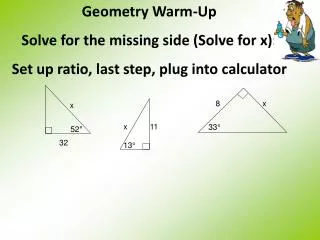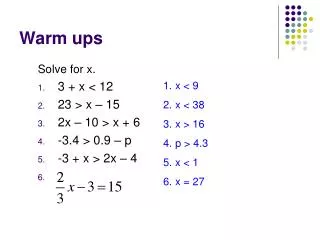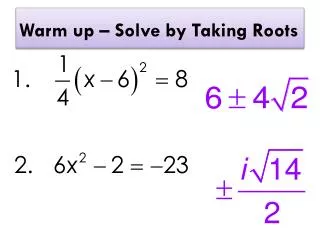
Warm up – Solve by Taking Roots
200 likes | 375 Views
This resource provides a comprehensive guide to using the discriminant to determine the number and type of solutions for quadratic equations. The discriminant helps identify whether there are two distinct real roots, one real root, or two imaginary roots. With visual tools like foldable notes, students will learn to classify the discriminant as positive, zero, or negative, alongside examples demonstrating how to apply the quadratic formula to find solutions. Engage with practice questions to reinforce your understanding of quadratic roots.


Warm up – Solve by Taking Roots
E N D
Presentation Transcript
The Discriminant tells how many & what type of solutions the quadratic has.
If the discriminant is POSITIVE, then you will have 2 real roots. If the discriminant is ZERO, then you will have 1 real root. If the discriminant is NEGATIVE, then you will have 2 imaginary roots.
Discriminant Foldable Notes Fold your paper over (top to bottom leaving about an inch at the bottom). Positive ZerO Negative
Discriminant 2 real Roots ZerO Negative
Discriminant One real Root Positive Negative
Discriminant 2 imaginary Roots Positive ZerO
Determine the number & types of roots.Example: 1 2 Imaginary Roots
Determine the number & type of roots.Example: 2 1 Real Root
Determine the number & type of roots.Example: 3 2 Real Roots
Quadratic Formula Everything must be on the same side of the equals sign before solving
Homework Solving Quadratics WS