Historical Perspective
This article delves into the historical perspectives on immunity, tracing its evolution from early observations of disease protection by Thucydides during the Athenian plague in 430 BC to modern immunological advances. Key milestones include Mary Wortley Montagu’s inoculation practices in 1718, Edward Jenner's breakthrough with smallpox in 1798, and Louis Pasteur's studies in the 1880s that established foundational concepts of vaccination and immunity. The article also addresses innate and adaptive immunity, along with the implications of immune dysfunction like allergies and autoimmune diseases.

Historical Perspective
E N D
Presentation Transcript
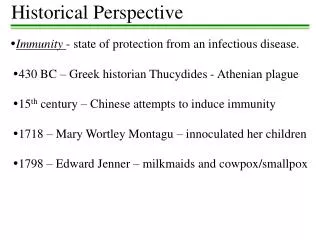
Historical Perspective Immunity - state of protection from an infectious disease. 430 BC – Greek historian Thucydides - Athenian plague 15th century – Chinese attempts to induce immunity 1718 – Mary Wortley Montagu – innoculated her children 1798 – Edward Jenner – milkmaids and cowpox/smallpox
Historical Perspective Louis Pasteur early 1880’s – Cholera and chickens Attenuation hypothesis 1881 – Testing the hypothesis with anthrax and sheep 1885 – Rabies vaccine
Historical Perspective 1890 - Behring and Kitasato – link serum to immunity 1883 – Metchnikoff – links cells (phagocytes) to immunity early 1900’s – many functions of immune serum 1930’s – Kabat - immunoglobulin/antibodies 1950’s – Glick – two types of lymphocytes
Historical Perspective 1900 – Paul Ehrlich – Selective theory 1950’s – Jerne, Talmadge and Burnet – clonal selection theory
Infection and Immunity pathogens – organisms causing disease pathogenesis – the means by which disease-causing organisms attach a host.
Innate and Adaptive Immunity Innate 1st line of defense Non-specific mechanisms Phagocytes and recognition molecules Adaptive 2nd line of defense Highly specific mechanisms Lymphocytes, antigen specific receptors, antibodies
Immune Dysfunction Allergies and asthma Autoimmune disease Immunodeficiency