Understanding Lipid Membrane Conformations through F-BAR Protein Interaction Dynamics
This project investigates the physical basis by which F-BAR proteins sculpt lipid membranes into specialized shapes for cellular compartmentalization. By utilizing biochemical and cellular assays, we generate membrane tubules with specific shapes, lipid compositions, and stiffness. Our approach combines experimental and theoretical methods to understand how the modulation of membrane deformation machinery impacts membrane organization and structure. We observe that structurally similar proteins yield distinct tubule properties and explore factors like protein-membrane interactions and assembly behaviors to explain these variances.

Understanding Lipid Membrane Conformations through F-BAR Protein Interaction Dynamics
E N D
Presentation Transcript
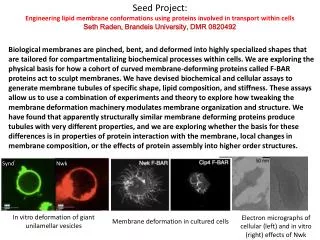
Seed Project: Engineering lipid membrane conformations using proteins involved in transport within cells Seth Raden, Brandeis University, DMR 0820492 Biological membranes are pinched, bent, and deformed into highly specialized shapes that are tailored for compartmentalizing biochemical processes within cells. We are exploring the physical basis for how a cohort of curved membrane-deforming proteins called F-BAR proteins act to sculpt membranes. We have devised biochemical and cellular assays to generate membrane tubules of specific shape, lipid composition, and stiffness. These assays allow us to use a combination of experiments and theory to explore how tweaking the membrane deformation machinery modulates membrane organization and structure. We have found that apparently structurally similar membrane deforming proteins produce tubules with very different properties, and we are exploring whether the basis for these differences is in properties of protein interaction with the membrane, local changes in membrane composition, or the effects of protein assembly into higher order structures. Synd Nwk In vitro deformation of giant unilamellar vesicles Membrane deformation in cultured cells Electron micrographs of cellular (left) and in vitro (right) effects of Nwk