Download
1 / 8
80 likes | 187 Views
In geometry, a perpendicular bisector is a line, ray, or segment that intersects another segment at its midpoint at a right angle. Points on this bisector are equidistant from the endpoints of the segment it bisects. This concept is essential in determining relationships between shapes. For example, in a triangle, the three perpendicular bisectors intersect at a point called the circumcenter, which is equidistant from all three vertices. This property allows for the construction of circumcircles around triangles.

E N D
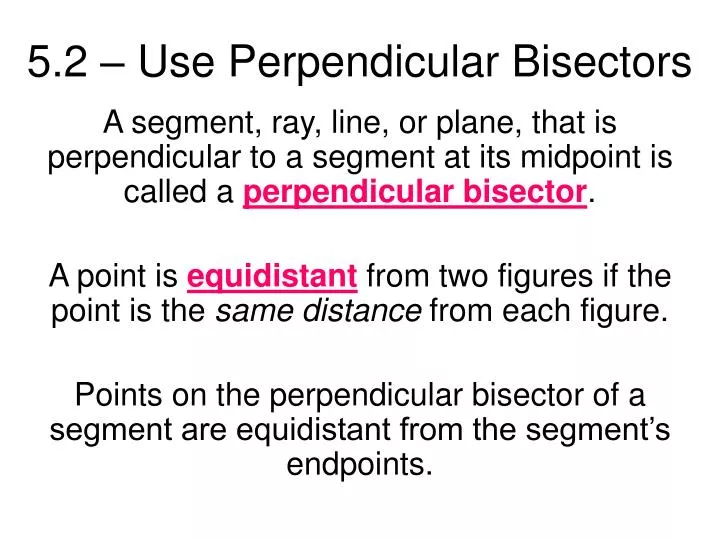
5.2 – Use Perpendicular Bisectors A segment, ray, line, or plane, that is perpendicular to a segment at its midpoint is called a perpendicular bisector. A point is equidistant from two figures if the point is the same distance from each figure. Points on the perpendicular bisector of a segment are equidistant from the segment’s endpoints.
5.2 – Use Perpendicular Bisectors Example 1: Line BD is the perpendicular bisector of Segment AC. Find AD.
5.2 – Use Perpendicular Bisectors Example 2: In the diagram, Line WX is the perpendicular bisector of Segment YZ. What segment lengths in the diagram are equal? Is V on Line WX?
5.2 – Use Perpendicular Bisectors CREATE AND FOLD TRIANGLES!!
5.2 – Use Perpendicular Bisectors When three or more lines, rays, or segments intersect in the same point, they are called concurrent lines, rays, or segments. The point of intersection of the lines, rays, or segments is called the point of concurrency. The three perpendicular bisectors of a triangle are concurrent and the point of concurrency has a special property.
5.2 – Use Perpendicular Bisectors The point of concurrency of the three perpendicular bisectors of a triangle is called the circumcenter of the triangle. The circumcenter P is equidistant from the three vertices, so P is the center of the circle that passes through all three vertices.