Physics Fundamentals: Work, Power, Energy Calculation Examples
200 likes | 294 Views
Learn about forces, energy transfer, work calculation, power, potential energy, kinetic energy, momentum, and conservation of momentum in physics through practical examples. Understand the equations and concepts easily.


Physics Fundamentals: Work, Power, Energy Calculation Examples
E N D
Presentation Transcript
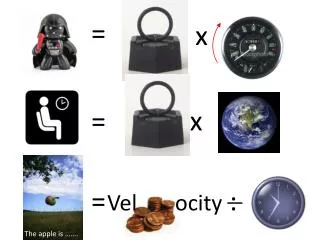
= x = x = : Velocity The apple is …….
= : = x = x x The apple is …….
P2.2.1 Forces and Energy - Objectives • Understand that if ‘work’ is done then a force is required. • Energy is transferred when work is done (e.g. against frictional forces). • How to calculate kinetic energy, power and potential energy.
Work done • Work done, force and distance are related by the equation: W = F x d • W is the work done in joules, J • F is the force applied in newtons, N • d is the distance moved in the direction of the force in metres, m
How much work is needed to push this plane 200m? 500N Force (to overcome friction) 200m in direction of force W = F x d = 500 x 200 = 100 000 Joules
Q1. A car needs to be pushed 200m, the friction of the tyres on the road is 75N. What is the work done? Q2. 10000J of energy is used to move a ship 1m. What was the force of the water resistance?
Power • Power is the work done or energy transferred in a given time. P = E / t P is the power in watts, W E is the energy transferred in joules, J t is the time taken in seconds, s
What is the power of the plane engine if it transfers 5000J of energy in 5 seconds? P = E / t = 5000 / 5 = 1000 W
Potential Energy • Gravitational potential energy is the energy that an object has by virtue of its position in a gravitational field. Ep= m x g x h • Ep is the change in gravitational potential energy in joules, J • m is the mass in kilograms, kg • g is the gravitational field strength in newtons per kilogram, N/kg • h is the change in height in metres, m
How much potential energy does this plane have when it flies at 1000m altitude? Ep = m x g x h Ep = 1000 x 10 x 1000 Ep = 10 000 000 J 1000kg mass 1000m height g = 10 N/kg
Kinetic Energy • The kinetic energy of an object depends on its mass and its speed. Ek= ½ m x v2 • Ek is the kinetic energy in joules, J • m is the mass in kilograms, kg • v is the speed in metres per second, m/s
How much kinetic energy does this plane have when it flies at 50 m/s? 50m/s 1000kg mass Ek = ½m x v2 = ½ x 1000 x 502 =
Momentum • Momentum is a property of moving objects: p = m x v • p is momentum in kilograms metres per second, kg m/s • m is the mass in kilograms, kg • v is the velocity in metres per second, m/s
How much momentum does this plane have when it flies at 50 m/s? 50m/s 1000kg mass p = m x v p = 1000 x 50 p = 50 000 kg m/s
Conservation of momentum The total momentum before an event is equal to the total momentum after the event.