Download
1 / 33
330 likes | 472 Views
Explore the foundations of evolutionary theory in biology, tracing its roots from early theological influences to modern scientific understanding. This chapter delves into pivotal concepts like fossil documentation, the influence of catastrophism and uniformitarianism, and the critical contributions of Robert Hooke, Lamarck, and Darwin. Discover how fossils are formed from sedimentary rocks, understand genetic variation and natural selection, and learn about the significant discoveries from Darwin’s voyage. This exploration reveals how species adapt and illustrate the dynamic history of life on Earth.

E N D
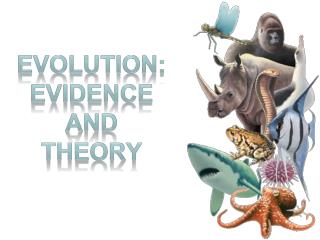
EvolutionEvidence and Theory Chapter 14 HonorsBiology
Early Biological Though • Heavily influenced by theology • All organisms were created simultaneously • Each distinct life-form was permanently fixed and did not change over time
Evolution- Is it true? • A genetic change within a population over time! • Population- interbreeding single-species group
Fossils- Documentation • Fossil - trace of a long-dead organism. • Sedimentary rock - formed by dust, sand, or mud deposited by wind or water over dead organism • Formed by hard body parts of an organism—shell, bones, teeth, or woody stems • Hard minerals replace the tissue of the organism leaving rocklike structures
Fossils • Mold– imprint in rock in the shape of an organism • limestone • Cast– forms when molds are filled with hard minerals Mold Cast
Limestone • Limestone – most abundant , non-classic sedimentary rocks. • Limestone is produced from the mineral calcite (calcium carbonate) and sediment. • Chalk is another type of limestone that is made up of very small single-celled organisms.
Robert Hooke 1635-1703 • He concluded that fossils are remains of plants and animals • He mostly studied “petrified wood” with the aid of the microscope • He hypothesized that living organisms had somehow been turned to rock
Non-evolutionary Explanations • Catastrophism • Georges Cuvier (1769-1832) • High numbers of species were created originally • Series of catastrophes produced rock layers • destroyed many species, preserving some as fossils • Modern day species are the survivors of these catastrophies
Uniformitarianism • James Hutton (1726-1797) and Charles Lyell (1797-1875) • Developed theory of uniformitarianism • Geologic change resulted from slow, continuous actions similar to those at work today
Distribution of Fossils • Nicolaus Steno (1638-1686) • “law of superpositon” – states that the top layers of stratum contain the youngest fossils while the lower ones are older • Determine the “relative age” of a fossil • “absolute age”- age in years determined by radiological evidence
Succession of Forms • Mass extinctions – brief periods during which large numbers of species disappears. • Resulted from drastic changes in the environment, volcanic activity or collisions with asteroids (may have blocked sunlight for long periods of time and decreased temp.)
Biogeography • Biogeography – is the study of the geographical distribution of fossils and of living organisms. • A comparison of fossil types with types of living organisms in the same geographic area • shows that new organisms arise in areas where similar forms already lived. • Ex: armadillos in North & South America where glyptodonts lived in the past.
Theories of Evolution • I. Lamarck’s Explanation: • He hypothesized that acquired traits were passed on to offspring. • Proposed that similar species descended from a common ancestor (fossil records)
Acquired Trait • It’s not determined by genes! • Occurs during an organism’s lifetime • result of the organism’s experience or behavior. • Ex: 1. Muscles on a body builder • 2. Giraffe’s necks did not get longer by trying harder and harder to reach tall trees- Genetic
Beginning of Modern Evolutionary Theory • II. Charles Darwin (1809-1882) & Alfred Wallace (1823-1913) • Darwin & Wallace announced their hypotheses at the same time • Darwin’s name became more associated with evolution The Origin of Species published
Darwin’s Voyage on the Beagle • Sailed in 1831 for five years • Collected specimens and kept careful records of his observations • Sailed to South America (Galapagos Islands) and the South Pacific
Darwin’s Findings • Collected 13 similar but separate species of finches. • Each finch species had a distinctive bill for specialized food source. • Implied that the finches shared a recent common ancestor
Darwin’s Theories • TWO THEORIES; • 1. DESCENT WITH MODIFICATION – The newer forms appearing in the fossil record are actually the modified descendants of older species • Organisms similar to each other- common ancestor • Organisms that are dissimilar -share a more remote ancestor
2. Modification by Natural Selection • MODIFICATION BY NATURAL SELECTION – states HOW evolution occurs. • Organisms best suited to their environment reproduces more successfully than other organisms Leaf tailed gecko
Based on 4 postulates Postulate- something taken as self-evident • 1. Individual members of a population differ • Variations arise purely by chance resulting from random mutations in DNA • 2. Variations are passed from parent to offspring • 3. Some individuals in a population survive and reproduce successfully but others do not • 4. Individuals with advantageous traits survive longest and leave the most offspring- natural selection
Adaptation- Adaptive advantage • A population of organisms adapt to their environment • # of genes for favorable traits increases • Fitness- a single genetic organism’s contribution to the next generation’s survival • A well adapted organism will reproduce successfully and have a high fitness