Download
1 / 22
220 likes | 414 Views
Dive into the world of polygons and their properties, from classifying quadrilaterals to calculating angles. Discover the sums of interior angles, diagonal relationships, and patterns in polygons. Complete a mini-lab with various polygon types and checkpoints to test your knowledge.

E N D
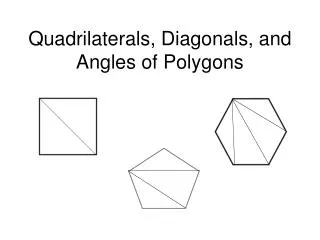
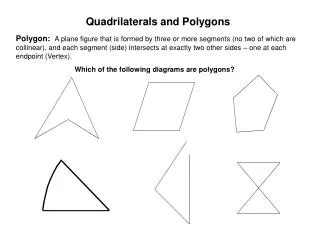
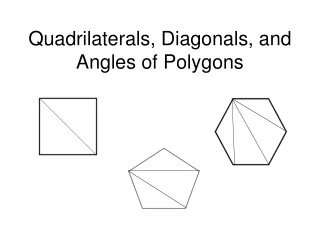
Quadrilaterals, Diagonals, and Angles of Polygons • A Polygon is a simple closed plane figure, having three or more line segments as sides • A Quadrilateral is any four-sided closed plane figure • A Diagonal a line segment that connects one vertex to another (but not next to it) on a polygon
Quadrilateral Angles • We know that the interior angles of a triangle add up to 180 degrees • How many degrees are in the interior angles of a quadrilateral?
Quadrilateral Angles • If we draw a diagonal from one vertex across to the opposite vertex, we see that we have formed two triangles • Therefore, the sum of two triangles will give you the measure of the interior angles of a quadrilateral • 180 + 180 = 360 degrees!
Quadrilateral Angles Checkpoint • Find the missing angle of a quadrilateral with the following measures: m 1 = 117 m 2 = 110 m 3 = 75 m 4 = 117 + 110 + 75 + x = 360 302 + x = 360 x = 58
Angles of Polygons Mini-Lab • Let’s explore this knowledge and how it relates to the angles of other polygons • Copy and complete the table below:
Angles of Polygons Mini-Lab • Draw a pentagon with diagonals from one vertex to each opposing vertex
Angles of Polygons Mini-Lab • Let’s explore this knowledge and how it relates to the angles of other polygons • Copy and complete the table below:
Angles of Polygons Mini-Lab • Draw a hexagon with diagonals from one vertex to each opposing vertex
Angles of Polygons Mini-Lab • Let’s explore this knowledge and how it relates to the angles of other polygons • Copy and complete the table below:
Angles of Polygons Mini-Lab • Draw a heptagon with diagonals from one vertex to each opposing vertex
Angles of Polygons Mini-Lab • Let’s explore this knowledge in how it relates to the angles of other polygons • Copy and complete the table below:
Angles of Polygons Mini-Lab • What patterns do you see as a result of our experiment? • The number of triangles in any polygon is always two less than the number of sides. • Therefore, if n = the number of sides of the polygon; the sum of interior angles of any polygon can be expressed as (n – 2)180!
Angles of Polygons Checkpoint • Find the sum of the measures of the interior angles of each polygon: 15-gon? 23-gon? 30-gon? (15-sided figure) (23-sided figure) (30-sided figure) 13 x 180 = 2340
Angles of Polygons Checkpoint • Find the sum of the measures of the interior angles of each polygon: 15-gon? 23-gon? 30-gon? (15-sided figure) (23-sided figure) (30-sided figure) 13 x 180 = 2340 21 x 180 = 3780
Angles of Polygons Checkpoint • Find the sum of the measures of the interior angles of each polygon: 15-gon? 23-gon? 30-gon? (15-sided figure) (23-sided figure) (30-sided figure) 13 x 180 = 2340 21 x 180 = 3780 28 x 180 = 5040
Regular Polygons • A regular polygon is one that is equilateral (all sides congruent) and equiangular (all angles congruent) • Polygons that are not regular are said to be irregular • If the formula for finding the sum of measures of interior angles of a polygon is (n-2)180, how would you find the measure of each angle of a regular polygon? ( n – 2 )180 n
Regular Polygons Checkpoint • Find the sum of the measures of the interior angles of each regular polygon and the measure of each individual angle: 15-gon? 23-gon? 30-gon? (15-sided figure) (23-sided figure) (30-sided figure) 13 x 180 = 2340 2340 / 15 = 156
Regular Polygons Checkpoint • Find the sum of the measures of the interior angles of each regular polygon and the measure of each individual angle: 15-gon? 23-gon? 30-gon? (15-sided figure) (23-sided figure) (30-sided figure) 13 x 180 = 2340 2340 / 15 = 156 21 x 180 = 3780 3780 / 23 = 164.35
Regular Polygons Checkpoint • Find the sum of the measures of the interior angles of each regular polygon and the measure of each individual angle: 15-gon? 23-gon? 30-gon? (15-sided figure) (23-sided figure) (30-sided figure) 13 x 180 = 2340 2340 / 15 = 156 21 x 180 = 3780 3780 / 23 = 164.35 28 x 180 = 5040 5040 / 30 = 168
Homework • Skill 4: Polygons (both sides) • 6-3 Skills Practice: Polygons and Angles • DUE TOMORROW!