Download
1 / 13
130 likes | 223 Views
Learn about Direct and Indirect Object Pronouns in Spanish. Discover how they answer different questions and their placement in sentences. Practice using them correctly with examples. Improve your Spanish language skills!

E N D
Object Pronouns Me, te, nos
Two Types of Object Pronouns • There are two types of object pronouns: Direct and Indirect • Direct Object (DO) pronouns answer the question “Who or what is receiving the action of the verb?” • Indirect Object (IO) pronouns answer the question "To whom?" or "For whom?" the action of the verb is performed. It tells us where the DO is going.
Example • The doctor writes me a prescription. Subject verb Indirect object Direct object • What does he write? • For whom does he write the prescription? Where is the prescription going? Me To Me • In Spanish this sentence would be: • El médico me escribeunareceta.
Indirect Object Pronounsanswer the question "To whom?" or "For whom?" • (to/ for) me = me (pronounced “may”) • (to/ for) you = te • (to/ for) him, her, it, you formal = le • (to/ for) us = nos • (to/ for) y’all = os • (to/ for) them, you all = les • Look familiar?
You have already used them! • Me gustan los deportes verb Subject IO • Literally this sentence means: • Sports are pleasing to me. verb Subject IO
You have already used them! • le duele la garganta IO verb Subject • Literally this sentence means: • (His) throat hurts (gives pain to) him Subject verb IO
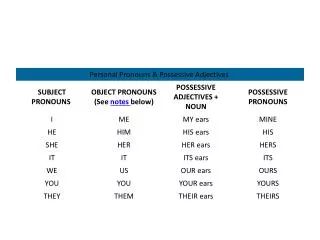
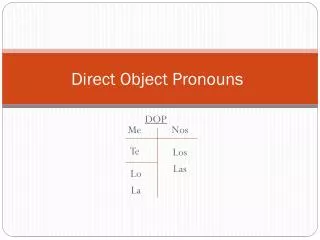
Direct Object Pronouns“Who or what is receiving the action of the verb?” • me = me • you = te • him, her, it, you formal = lo, la • us = nos • y’all = os • them, you all = los, las We will only use me, te, and nos in this chapter.
Examples • The doctors examine us. • Los médicosnosexaminan. Subject verb DO Subject DO verb • Whom or what do they examine? us • “Us” or “nos” is the direct object pronoun.
Examples Daddy, I adore you. • Papi, teadoro. DO Subject verb DO verb Subject (implied) • Whom or what do I adore? you • “You” or “te” is the direct object pronoun.
Did you notice? • Both DO and IO pronouns go before the verb. • Me, Te, and nos are the same for both sets of object pronouns • The verb agrees with the subject, NOT the objects.
Look again • El médicomeescribeunareceta. The verb matches the Subject The DO pronoun comes before the verb
Practicamos TE • ¿____ duele el estómago? Sí, me duele el estómago. • ¿Me escribes una carta? Sí, ____ escribo. • ¿Por qué te da una receta el médico? Porque____ duele la garganta. • Mi profesor de español ______ explica la lección porque no comprendemos la lección. TE ME NOS