Download
1 / 36
360 likes | 527 Views
This article explores the anatomic basis for speech lateralization in individuals, particularly right-handed adults, focusing on the predominant left hemisphere representation for speech functions. It discusses evidence from stroke and trauma patients, highlights the structural differences between hemispheres (such as the Broca's and Wernicke's areas), and examines the implications of these findings on aphasia syndromes, including characteristics of Broca's aphasia. It also addresses how environmental factors, such as literacy and language acquisition, influence speech lateralization.

E N D
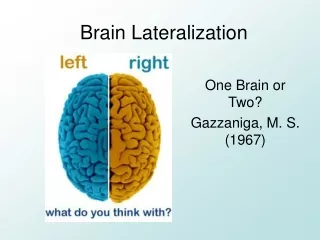
ANATOMIC BASIS FOR LATERALIZATION • speech lateralization in right-handers • following left hemisphere insult in 97% of stroke patients • following left hemisphere insult in 95% of head trauma patients • following left carotid Wada test in 95% of patients
ANATOMIC BASIS FOR LATERALIZATION • most right-handed adults have speech represented in the left hemisphere
Two hemispheres • Four lobes • Frontal • Temporal • Parietal • Occipital • Anatomic features • Sylvian fissure • Central sulcus • Broca’s area • Wernicke’s area • Arcuate fasciculus B W
ANATOMIC BASIS FOR LATERALIZATION • planum temporale larger in left hemisphere than right hemisphere in dextrals • left Sylvian fissure longer and more horizontal than right Sylvian fissure in dextrals • left inferior frontal cortex larger in left hemisphere than right hemisphere • similar asymmetries in neonates, early hominids, some great apes
ANATOMIC BASIS FOR LATERALIZATION • less overlapping dendritic trees in left Wernicke’s area than right Wernicke’s area • more discrete processing for rapid transition of speech sounds
ANATOMIC BASIS FOR LATERALIZATION • speech lateralization in left-handers • sinistrals more likely to be aphasic following left hemisphere insult or right hemisphere insult • aphasia milder and briefer in left-handers • aphasia milder and briefer in mixed-handers and in patients with mixed family handedness
ENVIRONMENTAL BASIS FOR LATERALIZATION • speech lateralization is affected by experience • right-handed illiterates and partial illiterates are less likely to have strongly lateralized speech • aphasia follows insult to the left hemisphere or the right hemisphere in illiterate right-handers • aphasia for a recently acquired second language can follow right hemisphere insult in a right-hander, sparing the mother tongue in left hemisphere
Non-fluent speech effortful telegraphic agrammatic Fluent speech melodic circumlocutory empty content FLUENCY
COMPREHENSION • Single word comprehension • Point to the pencil • [present two objects] - point to the pencil • [present one object] - is this a pencil?
sentence-picture matching Fran showed her baby the pictures SENTENCE COMPREHENSION • Fran showed her the baby pictures
SENTENCE COMPREHENSION Object manipulation “make the blue block be above the white block”
REPETITION • Multi-syllabic words • “constitutional” • Phrases • “methodist episcopal” • Sentences • “no ifs, ands, or buts”
NAMING • Confrontation naming • name demonstrated object spontaneously • Recognition naming • choose correct name for demonstrated object • Prompts • semantic • phonemic
BROCA’S APHASIA • non-fluent speech • effortful, telegraphic, agrammatic • comprehension • intact single word comprehension • agrammatic sentence comprehension
SENTENCE COMPREHENSION IN BROCA’S APHASIA • Good comprehension of sentences with typical word order • Poor comprehension of sentences with non-canonical word order
SENTENCE COMPREHENSION • grammatical role assignment in sentences with subject-relative center-embedded clauses • grammatical role is assigned indirectly via a trace that is phonetically silent The eaglei that ti chased the hawk was fast.
SENTENCE COMPREHENSION • grammatical role assignment in sentences with object-relative center-embedded phrases • word order is non-canonical • the antecedent noun must be kept in mind for many words until the trace is encountered The eaglei that the hawk chased ti was fast.
SENTENCE COMPREHENSION IN BROCA’S APHASIA • impaired grammatical phrase structure knowledge • loss of traces • without traces, grammatical roles assigned on the basis of alternative strategies • use of semantic constraint • The worm that the eagle ate was tasty • dependence on word order strategy • First noun is subject/agent
SENTENCE COMPREHENSION IN BROCA’S APHASIA • processing limitations • slowed lexical retrieval impairs grammatical processing • on-line processing of grammatical phrases limited by failure to retrieve words exactly when needed in course of sentence processing
SENTENCE COMPREHENSION IN BROCA’S APHASIA * • slowed lexical retrieval during semantic priming • slowed trace retrieval in object-relative center-embedded sentences • cross-modality lexical decision priming the trace at gap and pregap locations • Swinney et al, 1996 The eagle that the hawk with brown feathers *P* chased *G* was fast.
SENTENCE COMPREHENSION IN BROCA’S APHASIA • processing limitations • Verbal short-term memory limitation • Poor retention of head noun until trace is encountered while processing sentence material • Broca’s aphasics have impaired verbal short-term memory
subject-relative Short linkage Long linkage object-relative short linkage long linkage fMRI SENTENCE COMPREHENSION • FOUR SENTENCE CONDITIONS • PROBE AGENT OF ACTION • did male or female perform action in sentence?
fMRI SENTENCE COMPREHENSION • GRAMMATICAL FACTOR • subject-relative center-embedded sentence • grammatically simpler (typical word order) • The boyi from Boston that ti chased the girl with the long brown hair is friendly • object-relative center-embedded sentence • grammatically more complex (non-canonical word order) • The boyithat the girl chased ti with the long brown hair from Boston is friendly
fMRI SENTENCE COMPREHENSION • COGNITIVE RESOURCE FACTOR • short linkage sentence • less working memory demands • The boyifrom Boston that ti chased the girl with the long brown hair is friendly • long linkage sentence • more working memory demands • The boyi with the long brown hair from Boston that ti chasedthe girl is friendly
SENTENCE COMPREHENSION • Sentence comprehension compared to pseudofont baseline in 15 young healthy adults • A: subject-relative short linkage • B: subject-relative long linkage • C: object-relative short linkage • D: object-relative long linkage
SENTENCE COMPREHENSION • Sentence comprehension compared to pseudofont baseline in 11 healthy seniors with good comprehension • A: subject-relative short linkage • B: subject-relative long linkage • C: object-relative short linkage • D: object-relative long linkage
SENTENCE COMPREHENSION • Sentence comprehension comparing 11 healthy seniors and 13 young subjects for object-relative long linkage sentences • A: seniors > young • B: seniors < young
FRONTOTEMPORAL DEGENERATION • Clinical subgroups • Progressive aphasia • Executive limitation • Personality change • MRI scan • Relative atrophy in frontal and temporal distribution R L
PROGRESSIVE NON-FLUENT APHASIA • Expression • hesitant, effortful, telegraphic speech • oral, written • Comprehension • agrammatic sentence comprehension • oral, reading
PERFUSION fMRI IN FTD • Grammatical aspects of sentence comprehension in FTD are correlated with left frontal defect
DYSEXECUTIVE SYNDROME • limited working memory • impaired planning, problem-solving • inhibitory control deficit • perseverative, echolalic, perceptually bound, impulsive
PERFUSION fMRI IN FTD • Semantically-guided category naming fluency in FTD is correlated with left frontal defect
SENTENCE COMPREHENSION IN FTD SUBGROUPS • Comprehension of sentences with subordinate clauses • PNFA patients more impaired than EXEC patients • 100% of individual PNFA patients differ significantly from healthy controls
CORTICAL RECRUITMENT DURING SENTENCE COMPREHENSION IN FTD • PNFA patients (n=3) with grammatical comprehension difficulty do not recruit left inferior frontal cortex (BA 45/47) • EXEC patients (n=5) with limited short-term memory do not recruit BA 6/44 PNFA patients EXEC patients