Understanding the Compound Microscope: Parts, Characteristics, and Functions
The compound microscope is an essential tool in scientific observation, utilizing multiple lenses to magnify objects effectively. Its key features include magnification, which enlarges the appearance of an object without altering its physical size, and resolution, determining the clarity of the image. Total magnification is calculated by multiplying the ocular and objective lens magnifications. Key components include the ocular lens, body tube, nosepiece, objectives, stage clips, and light source. Understanding these parts enhances the use of this powerful instrument in various fields of study.


Understanding the Compound Microscope: Parts, Characteristics, and Functions
E N D
Presentation Transcript
Topic One Microscope Notes
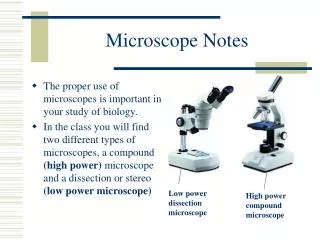
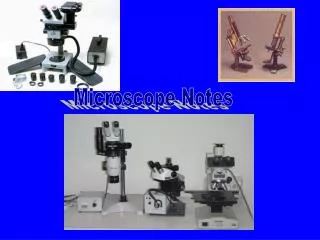
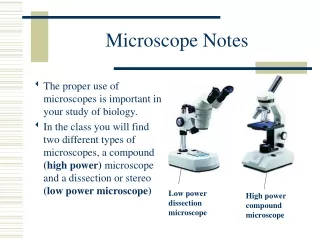
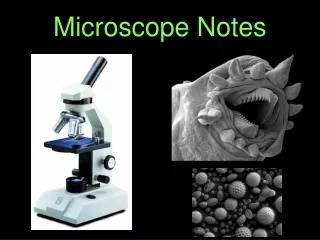
Compound Microscope • A microscope that uses multiple lenses to magnify the image of an object
Characteristics • Magnification: enlarging something in appearance but NOT in physical size • Resolution: how clear an image is, focus
Total Magnification = • ocular magnification X objective magnification
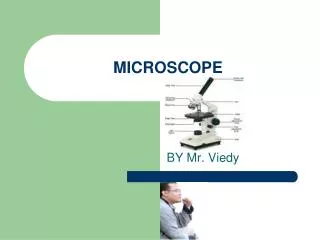
5. Ocular 12. Body tube 11. Stage clips 6. Nosepiece 3. Arm 4. Objectives 7. Coarse adjustment 2. Stage 10. Diaphragm 8. Fine adjustment 9. Light source 1. Base
5. Ocular 12. Body tube 6. Nosepiece 7. Coarse adjustment 4. Objectives 8. Fine adjustment 11. Stage clips 3. Arm 2. Stage 10. Diaphragm 9. Light source 1. Base