Understanding XML Namespaces: Techniques for Disambiguation in Semantic Web
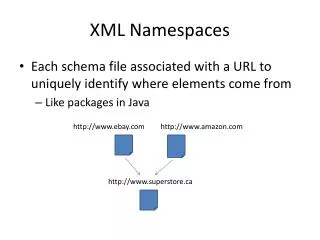
XML namespaces are essential for disambiguating elements and attributes from different XML applications using prefixes. Each prefix is bound to a namespace URI, allowing for clear identification of elements, avoiding conflicts, and enhancing organization in XML documents. With practical examples illustrating namespaces in action, such as mail and telecom addresses, this guide demonstrates how to effectively apply namespace bindings and handle ambiguous tags. For more in-depth information, visit the W3C resources linked within.

Understanding XML Namespaces: Techniques for Disambiguation in Semantic Web
E N D
Presentation Transcript
XML Namespaces Namespaces N'spaces CS6795 Semantic Web Techniques
XML Namespaces and Programming-Language Modules • XML namespaces are akin to namespaces, packages, and modules in programming languages • Disambiguation of element – and attribute – names from different XML applications (“spaces”) through different prefixes • A prefix is separated from the local name by a “:”, obtaining prefix:name tags • Namespaces can be seen as a layer on top ofXML 1.0, since prefix:name is again a valid tag name and namespace bindings are ignored by some tools N'spaces CS6795 Semantic Web Techniques
Namespace Bindings • Prefixes are bound to namespace URIs by attaching an xmlns:prefix attribute to the prefixed element or one of its ancestors, prefix:name1 ,...,prefix:namen • The value of the xmlns:prefix attribute is a URI, which may or (unlike for schemas!) may not point to a description of the namespace • An element can use bindings for multiple name-spaces via attributes xmlns:prefix1 ,...,xmlns:prefixm • More at http://www.w3.org/TR/xml-names andhttp://www.w3.org/2001/tag/doc/nsDocuments N'spaces CS6795 Semantic Web Techniques
Namespaceless Example:Address Variant Namespaceless XML Markup: <address> <name>Xaver M. Linde</name> <street>Wikingerufer 7</street> <town>10555 Berlin</town> <bill>12.50</bill> <phone>030/1234567</phone> <phone>030/1234568</phone> <fax>030/1234569</fax> <bill>76.20</bill> </ address> bill is ambiguous tag (name clash from two XML applications) N'spaces CS6795 Semantic Web Techniques
Two-Namespace Example: Snail-Mail and Telecoms Address Parts Namespace XML Markup: <mail:address xmlns:mail="http://www.deutschepost.de/" xmlns:tele="http://www.telekom.de/"> <mail:name>Xaver M. Linde</mail:name> <mail:street>Wikingerufer 7</mail:street> <mail:town>10555 Berlin</mail:town> <mail:bill>12.50</mail:bill> <tele:phone>030/1234567</tele:phone> <tele:phone>030/1234568</tele:phone> <tele:fax>030/1234569</tele:fax> <tele:bill>76.20</tele:bill> </ mail:address> bill disambiguation through mailand tele prefixes N'spaces • The root element, mail:address, as well as the children mail:name,mail:street, mail:town,and mail:bill, use the mail prefix, bound to a deutschepost URI • The tele:phone,tele:fax,andtele:bill children use the tele prefix, bound to a telekom URI CS6795 Semantic Web Techniques