Download
1 / 7
70 likes | 201 Views
This content focuses on the techniques involved in evaluating trigonometric integrals and antiderivatives. It includes example problems, such as the integration of functions like ( int x sin(3x) , dx ) and other common trigonometric forms. Key identities such as Pythagorean and double angle formulas are discussed, along with a non-obvious antiderivative of tan and sec functions. Students are encouraged to practice problems from their textbook to reinforce their understanding of these concepts.

E N D
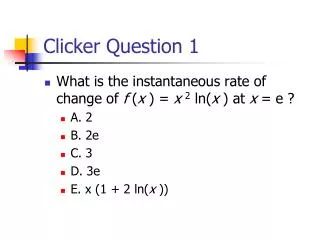
Clicker Question 1 • What is x sin(3x) dx ? • A. (1/3)cos(3x) + C • B. (-1/3)x cos(3x) + (1/9)sin(3x) + C • C. -x cos(3x) + sin(3x) + C • D. -3x cos(3x) + 9sin(3x) + C • E. (1/3)x cos(3x) - (1/9)sin(3x) + C
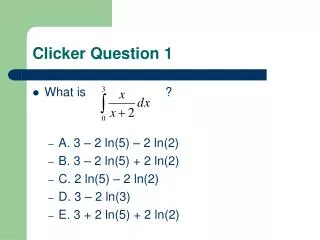
Clicker Question 2 • What is ? • A. e – 1 • B. ¼(e2 – 1) • C. ¼(e2 + 1) • D. 4(e2 + 1) • E. e + 1
Trig Integrals (2/7/14) • Trig integrals can often be done by recalling the basic trig derivatives and using some basic trig identities: • sin2(x) + cos2(x) = 1 • 1 + tan2(x) = sec2(x) (“Pythagorean Identities”) • cos(2x) = cos2(x) – sin2(x) (“Double angles”) = 2cos2(x) – 1 = 1 – 2sin2(x)
Three Examples • sin2(x) cos3(x) dx ?? • tan(x) sec4(x) dx ?? • sin2(x) dx
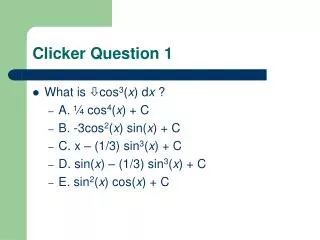
Clicker Question 3 • What is sin3(x) dx ? • A.cos(x) – (1/3)cos3(x) + C • B.(1/3)cos3(x) – cos(x) + C • C. x – (1/3)cos3(x) + C • D. (1/3)cos3(x) – x + C • E. (1/4)sin4(x) + C
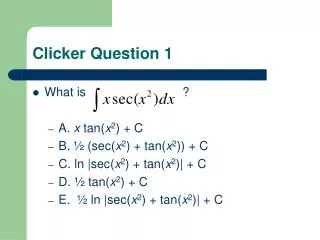
Another Non-Obvious Trig Antiderivative Fact • Recall that tan(x) dx = -ln(cos(x)) + C = ln(sec(x)) + C • What is sec(x) dx ?? (Hint: Multiply top and bottom by sec(x) + tan(x))
Assignment for Monday • Read Section 7.2. • Do Exercises 3, 7, 13 (Hint: We worked out in class what an antiderivative of sin2(t) is), 23, 55, 61.