Download
1 / 32
330 likes | 506 Views
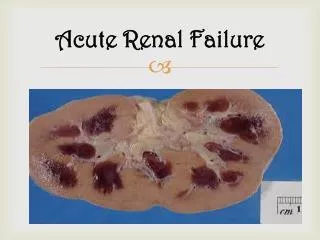
Acute renal failure (ARF) is a sudden decline in kidney function, characterized by decreased glomerular filtration rate (GFR) and impaired waste elimination. Classified as pre-renal, intra-renal, or post-renal, it affects 3-7% of hospitalized patients. Common signs include edema and changes in urine output. Diagnosis involves monitoring serum creatinine and urine production. Treatment focuses on addressing underlying causes, supporting kidney function, and managing complications. Preventive measures include hydration and careful medication use. Proper management improves patient outcomes.

E N D
Kidney Function • Detoxify blood • Increase calcium absorption • calcitriol • Stimulate RBC production • erythropoietin • Regulate blood pressure and electrolyte balance • renin
DEFENITION • Acute renal failure is defined as a decrease in GFR, generally occurring over hours to days sometimes over weeks that is associated with an accumulation of waste products including urea and creatinine , inability to concentrate urine, regulate fluid and electrolyte balance and maintain acid base homeostasis.
CLASSIFICATION • Based on precipitating and etiological factors, ARF is classified as:- • Pre renal . • Intra renal. • Post renal. • Based on amount of urine produced per day , it can be classified as:- • Anuric ARF ( <50 ml / day) • Oliguric ARF (50 – 400 ml / day) • Non oliguric ARF (> 400 ml / day)
EPIDEMEOLOGY • Acute kidney injury is common among hospitalized patients. • It affects some 3-7% of patients admitted to the hospital and approximately 25-30% of patients in the intensive care unit
etiology • Pre renal – decreased renal perfusion in the setting of undamaged parenchymal tissue. • Intrisic – structural damage to the kidney • Post renal – obstruction to urine flow. Trauma, rhabdomylosis, vessel thrombosis & drugs (contrast media, NSAID’s,ACEI,ARB etc) are also culprits. other risk factors – age, male gender, acute infection. next
Pre renal ARF • Decreased cardiac output. • CHF • Cardiomyopathy • MI • Hypovolemia • Major trauma • Burns • Hemorrhage • Increased renovascular resistance • Systemic vasodialation • Renovascular obstruction BACK
Intrinsic ARF • Prolonged pre renal azotemia • Nephrotoxic agents • Ischemic events • massive hemorrhage • septic shock • arterial thrombosis • Glomerular • Tubulo interstitial BACK
Post renal ARF • Bilateral ureteral obstruction • intraureteral • extraureteral • Pappilary necrosis • Bladder obstruction • Mechanical • Functional • Urethral obstruction BACK
pathophysiology • CIRCULATORY DISTURBANCES – Reduction in renal blood flow lead to ischemia. In response to reduced RBF, PG I₂ & PG E₂ increase blood flow to kidney. NSAID’s inhibit this. Ischemia —> oxidative phosphorylation stops & depletion of ATP.
TUBULAR & GLOMERULAR EVENTS Diminished renal function occur due to:- • back leak of glomerular filtrate into per tubular fluid . • tubular obstruction • decreased glomerularcappillary permeability.
SIGNS AND SYMPTOMS • SIGNS:- edema, coloured or foamy urine, orthostatic hypotension in volume depleted patients & hypertension in volume overloaded patients. • SYMPTOMS:- change in urinary habits, sudden weight gain, flank pain.
DIAGNOSIS • Introduced by the Acute Kidney Injury Network (AKIN), specific criteria exist for the diagnosis of ARF. • Rapid time course (less than 48 hours) • Reduction of kidney function • Rise in serum creatinine • Absolute increase in serum creatinine of ≥0.3 mg/dl (≥26.4 μ mol/l) • Percentage increase in serum creatinine of ≥50% • Reduction in urine output, defined as <0.5 ml/kg/hr for more than 6 hours
Patient History & Physical examination. • Urinalysis. • physical & chemical properties. • pH • concentrating ability. • Protein content. • Cells and casts. • sodium excretion.
LABORATORY DATA • GFR. • Creatinine clearance. • BUN. • Renal imaging & renal biopsy.
COMPLICATIONS • Metabolic acidosis, hyperkalemia, and pulmonary edema may require medical treatment with sodium bicarbonate, antihyperkalemic measures, and diuretics.
PREVENTION & TREATMENT • The goals of treatment for acute renal failureare to: • Correct or treat the cause of kidney failure. • Support the kidneys until they have healed and can work properly. • Prevent or treat any complications caused by acute renal failure.
NONPHARMACOLOGICAL • Adequate hydration and sodium loading prior to radio contrast dye administration. • when nephrotoxic agent use cannot be avoided, there may be ways to administer them in a manner that reduces their nephrotoxic potential. • Preventive dialysis.
PHARMACOLOGICAL • Diuretics. • Mannitol. • Loop diuretics. • Vaso active agents. • Dopamine • Fenoldopam • Calcium channel blockers. • ANP. • Acetylcysteine. • Glycemic control.
MANAGEMENT • ARF should be managed with hemodynamic support and volume replacement. • If immune related, initiate immuno suppressive therapy. • Regardless of etiology, supportive care should be given.
NONPHARMACOLOGICAL • Renal replacement therapy. • Intermittent hemodialysis. • Continuous renal replacement therapy.
PHARMACOLOGICAL • Therapy to prevent further insults . • If sepsis , antibiotic therapy. • Loop diuretics.
ELECTROLYTE MANAGEMENT • Hypernatrimia and fluid retention – complications of ARF. • Electrolytes are closely monitired. • Serum potassium monitored daily or twice daily. • Medication containing potassium should be avoided. • Hyperphosphatemia should be treated.
NUTRITIONAL INTERVENTION Provision of enteral nutrition – improved outcome. Dextrose contained in CRRT replacement solutions contribute significant amount of calories to patients regimen.
DRUG DOSING CONSIDERATION • Response to drug regimen include patient’s clearance, accumulation of fluids. • For drugs with narrow therapeutic index drugs serum concentration should be measured. • Reduction in cardiac output or liver function alter p’kinetic profile of the drug.
TREATMENT ALGORITHM • PATIENT IN ICU DEVELOPS ACUTE ARF • PHY EXAM,HISTRY,LAB VALUES SUGESTING ARF • DETERMINE CAUSE • INSTITUTE DIURESIS- frusemide 80 mg iv. • EXCLUDE REVERSIBLE CAUSE,TOXIC AGENTS, • INSTITUTE DIURESIS- frusemide 80 mg iv.
U.O> 1 ml/kg/hr NO YES • FUROSEMIDE 100 mg i.v. –u.o>1ml/kg/hr • FUROSEMIDE 400 MG IV • U.O> 1 ml/kg/hr YES • FUROSEMIDE 10mg/hr, u.o>1 ml/kg/hr until euvolemic. NO • FUROSEMIDE 400mg,chlrthiazide 500mg,metolazone 5 mg • U.O>1ml/kg/hr in 2 hr YES NO • CONT. CHLORTHIAZIDE 500mg i.v • CONSDR RRT
REFERENCE • Myrna Y. Munar, Harleen Singh,Acute Renal Disease In Richard A Helms,DavidQuan,Eric t. Herfindal et al(eds), Textbook of Therapeutics:drugs and disease management,8 thedition,page no: 1107-1135. • William Dager, Anne Spencer, Acute renal failure in Joseph T.Dipiro,Robert L. Talbert,GaryC.Yee et al(eds),Pharmacotherapy –A Pathophysiologic approach ,7 thedition,pg no: 723 – 741. • J. Marriot,S. Smith,Acute renal failure In Roger Walker, Clive Edwards Clinical pharmacy and therapeutics ,3rd edition, pg no: 229- 245.