
Enhancing Students' Problem-Solving Skills Through Innovative Technology and Methodology
E N D
Presentation Transcript
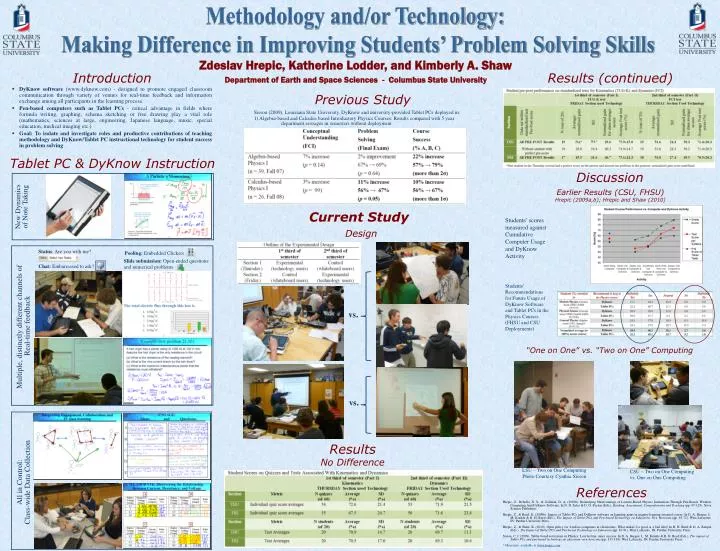
Methodology and/or Technology: Making Difference in Improving Students’ Problem Solving Skills Zdeslav Hrepic, Katherine Lodder, and Kimberly A. Shaw Department of Earth and Space Sciences - Columbus State University Introduction Results (continued) • DyKnow software (www.dyknow.com) - designed to promote engaged classroom communication through variety of venues for real-time feedback and information exchange among all participants in the learning process. • Pen-based computers such as Tablet PCs - critical advantage in fields where formula writing, graphing, schema sketching or free drawing play a vital role (mathematics, sciences at large, engineering, Japanese language, music, special education, medical imaging etc.) • Goal: To isolate and investigate roles and productive contributions of teaching methodology and DyKnow/Tablet PC instructional technology for student success in problem solving Previous Study Sisson (2009), Louisiana State University. DyKnow and university-provided Tablet PCs deployed in: 1) Algebra-based and Calculus based Introductory Physics Courses: Results compared with 5 year department averages in semesters without deployment. Tablet PC & DyKnow Instruction Discussion Earlier Results (CSU, FHSU)Hrepic (2009a,b); Hrepic and Shaw (2010) New Dynamics of Note Taking Current Study Design Students’ scores measured against Cumulative Computer Usage and DyKnow Activity Status: Are you with me? Pooling: Embedded Clickers Slide submission: Open-ended questionsand numerical problems Chat: Embarrassed to ask? Students’ Recommendations for Future Usage of DyKnow Software and Tablet PCs in the Physics Courses (FHSU and CSU Deployments) vs. Multiple, distinctly different channels of Real-time feedback “One on One” vs. “Two on One” Computing vs. Results No Difference LSU – Two on One Computing Photo Courtesy Cynthia Sisson CSU – Two on One Computing vs. One on One Computing All in Control: Class-wide Data Collection References Hrepic, Z., Rebello, N. S., & Zollman, D. A. (2009a). Remedying Shortcomings of Lecture-Based Physics Instruction Through Pen-Based, Wireless Computing And DyKnow Software. In N. H. Salas & D. D. Peyton (Eds.), Reading: Assessment, Comprehension and Teaching (pp. 97-129): Nova Science Publishers. Hrepic, Z., & Reed, K. (2009b). Impact of Tablet PCs and DyKnow software on learning gains in inquiry-learning oriented course. In D. A. Berque, L. M. Konkle & R. H. Reed (Eds.), The Impact of Tablet PCs and Pen-based Technology on Education: New Horizons (pp. 65-72). West Lafayette, IN: Purdue University Press. Hrepic, Z., & Shaw, K. (2010). Open policy for wireless computers in classrooms: What makes it a good or a bad idea? In R. H. Reed & D. A. Berque (Eds.), The Impact of Tablet PCs and Pen-based Technology on Education (pp. 83-91). West Lafayette, IN: Purdue University Press. Sisson, C. J. (2009). Tablet-based recitations in Physics: Less lecture, more success. In D. A. Berque, L. M. Konkle & R. H. Reed (Eds.), The impact of Tablet PCs and pen-based technology on education: new horizons (pp. 133-139). West Lafayette, IN: Purdue University Press. * More info available at www.hrepic.com