HOW A MICROHYDROPOWER SYSTEM WORKS
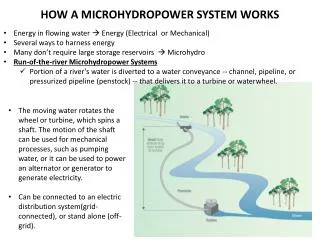
Microhydropower systems convert the energy from flowing water into usable electricity or mechanical power. By diverting a portion of a river's flow through channels, pipelines, or penstocks, the moving water spins turbines or waterwheels connected to generators. This process does not require large storage reservoirs, making it suitable for many sites, including stand-alone or grid-connected applications. The potential site at Horsethief Reservoir demonstrates how microhydropower can efficiently utilize natural water resources for sustainable energy solutions.

HOW A MICROHYDROPOWER SYSTEM WORKS
E N D
Presentation Transcript
HOW A MICROHYDROPOWER SYSTEM WORKS • Energy in flowing water Energy (Electrical or Mechanical) • Several ways to harness energy • Many don’t require large storage reservoirs Microhydro • Run-of-the-river Microhydropower Systems • Portion of a river's water is diverted to a water conveyance -- channel, pipeline, or pressurized pipeline (penstock) -- that delivers it to a turbine or waterwheel. • The moving water rotates the wheel or turbine, which spins a shaft. The motion of the shaft can be used for mechanical processes, such as pumping water, or it can be used to power an alternator or generator to generate electricity. • Can be connected to an electric distribution system(grid-connected), or stand alone (off-grid).
POTENTIAL SITE FOR THE MICROHYDROPOWER SYSTEM AT HORSETHIEF RESERVIOR