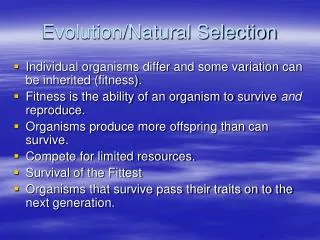
Evolution by Natural Selection
Discover the journey of HMS Beagle and Darwin's observations in the Galapagos Islands. Learn how Darwin and Wallace developed the theory of evolution by natural selection simultaneously, explaining the diversity of life. Explore Darwin's inquiries into the variations and similarities among organisms, leading to the groundbreaking Theory of Evolution by Natural Selection. Dive into the significance of Darwin's observations and the evidence he gathered to support his theory. Delve into the influence of other scientists such as Lamarck, Lyell, and Wallace in shaping evolutionary thought. Uncover the remarkable adaptations of Galapagos iguanas, giant tortoises, and Darwin's finches that showcase the concept of evolution through natural selection.

Evolution by Natural Selection
E N D
Presentation Transcript
Evolution by Natural Selection CK12.org Life Science for Middle School
Lesson Objectives • Describe the voyage of the HMS Beagle. • Describe Darwin’s observations in the Galapagos Islands. • Describe how both Darwin and Wallace developed the theory of evolution by natural selection at the same time.
Darwin’s Observations • Why are organisms different? • Why are organisms similar? • Why are there so many different types of organisms?
The Theory of Evolution by Natural Selection Charles Darwin was an English Natural Scientist 19th century
The Theory of Evolution by Natural Selection • One of the most important theories in life science. • Explains why species change over time. • Darwin spent 20 years making observations to develop this theory.
On the Origin of Species by Means of Natural Selection. • Published in 1859 • Describes Darwin’s observations and • Evidence he collected • To formulate the Theory of Evolution http://spencer.lib.ku.edu/exhibits/darwin/originb.jpg
Darwin’s Journey of Observations Voyage of the HMS Beagle http://en.wikipedia.org/wiki/HMS_Beagle
The giant tortoise is a unique animal found only in the Galápagos Islands. There are only about 200 tortoises remaining on these islands. Giant Tortoises
Darwin’s Finches • Most studied. • Each island had its own distinct species. • Beaks differed in size and shape.
Darwin’s Finches • The finches came from the same ancestor. • Evolved to adapt to different food sources.
What happened next? • Darwin returned to England. • Studied for another 20 years. • Wrestled with his religious views especially ones that told him that organisms never change and never go extinct and the world is only 6,000 years old.
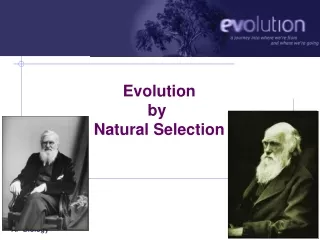
Influence of Other Scientists • Jean Baptiste Lamarck – Acquired Traits • Charles Lyell – Uniformitarianism • Alfred Wallace – Published similar theory along with Charles Darwin. Alfred Wallace developed a similar theory of evolution by natural selection.
Vocabulary • Charles Lyell • Charles Darwin • evolution • Galapagos islands • Jean-Baptiste Lamarck
Citations • https://encrypted-tbn3.gstatic.com/images?q=tbn:ANd9GcQ4e0BHJEgJOIpmb4lkaDtaqD3MgbK7ih2hADa4aFzZKvAGqJF1 • https://encrypted-tbn3.gstatic.com/images?q=tbn:ANd9GcRp6MiNaHa14Lz__GIkH0NrdeknyIuIDjd_xLtp5xf4g11AvJzpiw • https://encrypted-tbn3.gstatic.com/images?q=tbn:ANd9GcRpr_3REK4qTEZcERTMzKzt9zAtQYpCepQBBFCvaqAlrV8FS5m12A • https://encrypted-tbn0.gstatic.com/images?q=tbn:ANd9GcQTOxm49vkoS1AYNtWJR2zqKadHHYsqfKGGbEF87Am92A7KL6Dp