Taxonomy (Naming and Grouping)
130 likes | 283 Views
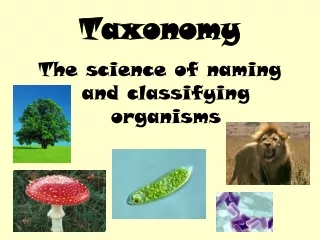
Taxonomy is the science of naming and grouping organisms, crucial for understanding the diversity of life. The common names we encounter, like Florida panther or cougar, refer to the same species, emphasizing the necessity of a universal naming system. Developed by Carl Linnaeus in the 18th century, the binomial nomenclature provides a two-part scientific name, distinguishing species accurately. This classification method, including the seven taxonomic ranks, aids scientists in studying evolutionary relationships and ensures clarity in communication about biodiversity.


Taxonomy (Naming and Grouping)
E N D
Presentation Transcript
Taxonomy (Naming and Grouping)
Why is a naming system important? Have you seen a… • Florida panther? • Cougar? • Mountain lion? • Catamount? • Puma? • They are all the SAME animal! • Their difference is their regional “common name”
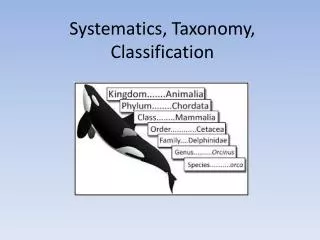
The origins of taxonomy • Taxonomy → grouping and naming of organisms • to understand the variety of life • to avoid confusion of regional names • Carl (Carolus) Linnaeus (1707-1778) • developed a binomial nomenclature (2-part name), now called the scientific name • developed a 7-level (taxon) classification • (domain), kingdom, phylum, class, order, family, genus, species • Dreaded King Philip Came Over For Great Spaghetti • Did King Philip Come Over From Glorious Spain? • Dumb Kids Playing Chicken On Freeways Go Splat
The Three Domains (added in 1990) (…eukaryotes) (…”common” prokaryotes) (…“ancient” prokaryotes)
Taxonomic groups Beginning with domain, each successive level of classification becomes more specific • Organisms within the same group have more in common with one another than those within the next largest group Members of a genus share more in common than members of a family
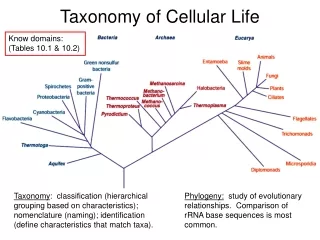
Kingdoms and Domains The Three Domains Archaea Bacteria Eukarya The Six Kingdoms Archaea Bacteria Protista Plantae Fungi Animalia
What is a Cladogram? • Cladogram → diagram that shows evolutionary relationships between organisms • Helps scientists understand how one lineage broke away from another in the course of evolution
What is a Dichotomous Key? • Dichotomous key → classification used to identify unknown organisms • Based on visible similarities