Download
1 / 12
140 likes | 301 Views
Economies of scale. Toyota. Billington’s custom cars. Which company can make cars more cheaply? Why?. Economies of scale. As a company gets bigger, it can make things more cheaply. Definition = As a company increases its scale of production average costs fall. Average costs.

E N D
Toyota Billington’s custom cars Which company can make cars more cheaply? Why?
Economies of scale • As a company gets bigger, it can make things more cheaply. • Definition = As a company increases its scale of production average costs fall.
Average costs • If the total cost of making 100 cars is $1,000,000, the average cost is $10,000 per car. • If the total cost of making 1,000 cars is $2,000,000, the average cost is ????
Take a minute • You manage a supermarket. As a result of growth, you have achieved economies of scale. • How will this effect the prices you charge, number of customers, and profits?
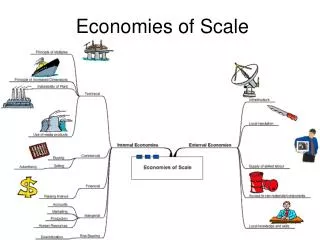
Internal Economies of scale • Technical • Managerial • Financial
Internal Economies of scale • Purchasing • Marketing • Risk-bearing
External Economies of Scale • Labour force • Support services and suppliers • Co-operation
Diseconomies of Scale • Definition = Increasing average costs as a result of an increase in the scale of operation • Co-ordination • Motivation • Communication
In pairs • Explain the Economies and Diseconomies of scale Starbucks may achieve. • Jogjakarta is a centre for Batik. What external economies of scale might there be for Batik businesses in Jogjakarta
Reasons for small business surviving • Diseconomies of scale • Size of the market • Flexibility • Personal Service
Case study • Pg593 a-d