Download
1 / 18
180 likes | 329 Views
Explore the diverse world of reptiles with insightful information presented by educator Rhonda Hawley. Learn about the four main types of reptiles: lizards and snakes, crocodiles and alligators, turtles and tortoises, and tuataras. Discover intriguing facts including snakes' unique movement, turtles' protective shells, and the endangered tuatara found only in New Zealand. From fascinating body adaptations to unique behaviors, this overview offers a glimpse into the lives of these remarkable creatures. Dive into the world of reptiles today!

E N D
Revealing Reptiles Rhonda Hawley, Educator, Developed with funding from the Mathematics & Science Center
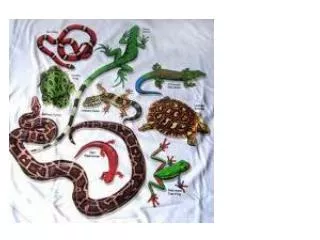
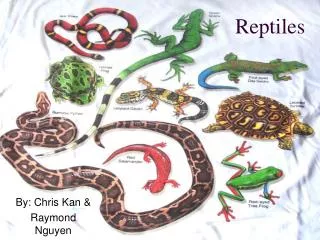
Revealing Reptiles There are four kinds of reptiles: 1) lizards and snakes; 2) crocodiles and alligators; 3) turtles and tortoises; 4) tuataras. http://mathinscience.info
Snakes! Snakes have a very flexible backbone with lots of vertebra. This allows them to move in an “S” pattern. Snakes have dry, scaly skin. http://mathinscience.info
Some snakes keep on growing until they are “giant-sized”. Snakes can re-grow old teeth when they lose them. http://mathinscience.info
Snake eggs usually have a leathery shell. Most snakes bury their eggs in the ground. http://mathinscience.info
Snakes crawl out of their old skin, usually leaving it behind in one piece. http://mathinscience.info
Turtles and Tortoises! The turtle and tortoise shell is really their backbone and ribs, which have grown outside of their skin to protect them. http://mathinscience.info
Crocodiles and Alligators! Crocodiles and alligators live mostly in the water. They are meat eaters. http://mathinscience.info
Crocodiles and alligators lay their eggs on land. They take good care of their young. They grow very, very large in a lifetime. http://mathinscience.info
Crocodiles and alligators can usually be found baking in the sun. They will also use the water to help them to cool off or to keep them warm. http://mathinscience.info
Tuatara! Tuatara can only be found on the islands of New Zealand. They are protected in New Zealand because they are an endangered species. http://mathinscience.info
The tuatara eats beetles, spiders, slugs, snails, grasshoppers, earthworms, as well as bird eggs, baby birds and small lizards. http://mathinscience.info
Tuataras do lay eggs like most reptiles but the eggs do not hatch for a year or more. http://mathinscience.info
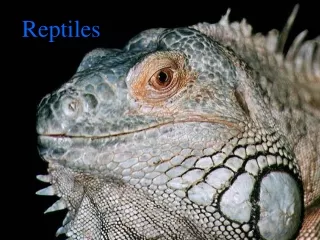
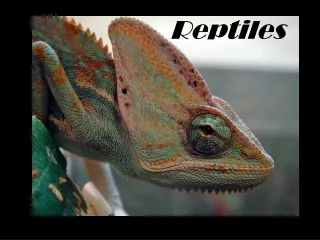
Lizards! There are over 3,000 kinds of lizards. Most lizards live on the ground, some live in trees, some burrow, and some live in the water. http://mathinscience.info
All lizards have “super” long tongues. They can “taste” smells in the air and on the ground, using their tongue. http://mathinscience.info
Lizards have great claws for gripping. They also use their tail for gripping and keeping them attached to tree branches. http://mathinscience.info
COOL FACTS! • Reptiles bodies are covered in scales, which keep their bodies from drying out. • Snakes need hot air temperatures to help them digest their food. • Thousands of male garter snakes hibernate together for warmth. • The poisonous black mamba is the fastest snake. It can move up to 12 mph (19 km/h). • The crocodile will often open its mouth so that the sun’s heat warms the blood vessels in its mouth. This helps to warm its body. • The Marion’s tortoise is thought to be the world’s longest lived animal. It can live for 150 years. http://mathinscience.info
Slides 2 – 10 and 14 - 16 : Smithsonian National Zoological Park; Reptiles & Amphibians photo gallery Photographer: Jessie Cohen http://natzoo.si.edu/Animals/PhotoGallery/ReptilesAmphibians/default.cfm Slides 11 & 13 : Department of Conservation Mount Bruce National Wildlife Center www.mtbruce.doc.govt.nz/tuatara.htm Slide 12 : Tuatara Photographer: Michael Schneider www.bigjude.com/Tuatara.html Photograph Credits http://mathinscience.info