Download
1 / 13
130 likes | 232 Views
This study investigates travelers' willingness to pay for high-quality travel information amid recurrent congestion and uncertain travel conditions. By utilizing data from a survey of TATS callers, the research analyzes factors influencing payment preferences, revealing that travelers are more likely to invest in information under beneficial circumstances. The findings highlight the potential for personalized travel information and the implications for commercialization, providing valuable insights for both public agencies and private sector innovations in transportation information services.

E N D
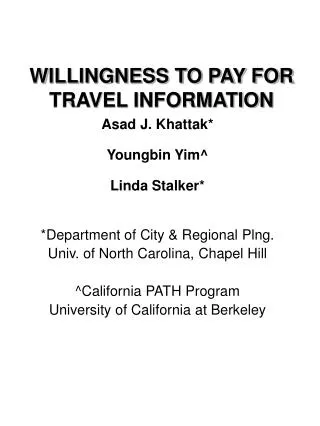
WILLINGNESS TO PAY FOR TRAVEL INFORMATION Asad J. Khattak* Youngbin Yim^ Linda Stalker* *Department of City & Regional Plng. Univ. of North Carolina, Chapel Hill ^California PATH Program University of California at Berkeley
Importance • Incident & recurrent congestion • Data collection, processing & dissemination • Are people willing to pay for high quality info? • Public versus private resources • Field Operational Tests & deployment: TravInfo • Traveler Advisory Telephone System
Literature Real-time travel info in large US cities: • Electronic information increases shifting • Information valuable in uncertain travel conditions • Info content, quality and medium • Travelers willing to pay in certain “high benefit” situations • TravInfo, SmartTraveler, Travlink
Gaps In existing studies: • Factors that influence willingness-to-pay for travel info? • What kind of info will users pay for? • Is there demand for transit info? • What can we learn from FOT/implementations in larger cities?
The Survey • CATI: April 1997 of TATS callers • Sample = 511 (quota for traffic & transit calls; gender) • Sample comparisons showed differences--non-generalizable • Information seekers • Focus on trip called (TATS) about: • Different purposes • Skip patterns
Survey Questions Reported & Stated preferences • RP: Last month, how frequently did you call TATS? • SP scenarios: About how many times will you call TATS if per-call charge was 25 cents, 50 cents, 1 dollar? • Give per call or monthly fee preference Other variables: • Travel decisions, socio-economic and context factors
Methodology Random-effects negbin reg. • Dependent variable is • RP: Calling frequency (1) • SP: Calling frequency (6) • Indep. Vars: Per-call fee, individual, household, travel characteristics • Potential biases: • Strategic bias--lose free service • Non-commitment bias--overstate W-T-P • Cognitive dissonance--unable to assess free service’s worth
Methodology - Model Estimated model accounts for: • Serial correlation • Over-dispersion • Heterogeneity (when mean variance ratio grows with higher means) • Does not yield marginal effects Skip patterns: • Missing data problem • Indicator variables
Conclusions • Response reasonable: Higher cost implies less use • Controlling for various factors & combining RP with SP • Information seekers willing to pay • Demand for personalized information • Other info sources complementary • Potential for transit improvement
Policy Implications Commercialization of travel info: • There is demand for TATS • Added benefits of personalization imp. to customers • Advertise TATS on comm. radio • TATS usage may grow (SmartTraveler) • In other areas: • Develop free-of-charge service • Gradually introduce charges: Longer commute routes & improvement potential
Directions for Further Research • Content of information • New media: Internet, PDA • Integration of info • Behavioral change • Network performance