Download
1 / 13
130 likes | 247 Views
This comprehensive guide covers essential information about Lithium, including its atomic structure, atomic mass of 6.939, and historical significance when it was discovered by Johann August Arfvedson in 1817. It explains key concepts such as protons, neutrons, and the characteristics of Lithium as a gas at room temperature. The glossary provides definitions of fundamental particles and terms related to atomic structure, helping readers to grasp the basics of atomic science in a clear and concise manner.

E N D
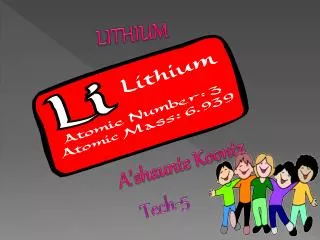
LITHIUM A’shaunte Koontz Tech-5
TABLE OF CONTENTS! • 1.COVER2. TABLE OF CONTENTS 3. ATOMIC # 4. ATOMIC MASS 5. SYMBOL 6. PROTONS 7. WHEN WAS IT FOUNDED 8. NUETRONS 9.ATOMIC STRUCTURE 10. GLOSSARY 11. solid liquid are gas.
Atomic # • is 4
Atomic mass • 6.939
SYMBOL • L.I
protons • 2 protons
When was it founded.? • Johann August Arfvedson 1817
NUETRONS • 1NUETRON
GLOSSARY • NUETRONS-an elementary particle having no charge, mass slightly greater than that of a proton, and spin of 1 / 2 : a constituent of the nuclei of all atoms except those of hydrogen. Symbol: n
Solid,liquid,and/or gas • It is a gas.!
GLOSSARY • PROTONS-a positively charged elementary particle that is a fundamental constituent of all atomic nuclei. It is the lightest and most stable baryon, having a charge equal in magnitude to that of the
glossary • Nucleus-acentral part about which other parts are grouped or gathered; core















![[PDF] Free Download The Forbidden Door By Dean Koontz](https://cdn4.slideserve.com/8004706/slide1-dt.jpg)
![[PDF] Free Download The Forbidden Door By Dean Koontz](https://cdn4.slideserve.com/8007291/slide1-dt.jpg)