Download
1 / 19
251 likes | 866 Views
This article delves into the realms of intelligence and personal constructs within psychology, covering topics such as the structure of intelligence, Gardner's multiple intelligences, artificial intelligence domains, mental associations, personal construct theory, George Kelly's constructs, and the Osgood's Semantic Differential. Discover the intricate connections between cognitive processes, diverse intelligence types, psychological associations, and the evaluation of individual constructs.

E N D
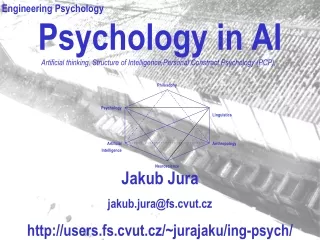
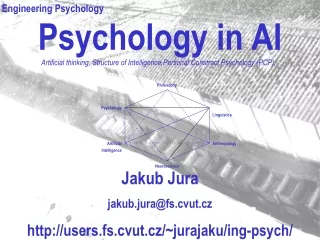
Engineering Psychology Philosophy Psychology Linguistics Artificial Intelligence Anthropology Neuroscience Psychology in AI Artificial thinking, Structure of Intelligence,Personal Constract Psychology (PCP), Jakub Jura jakub.jura@fs.cvut.cz http://users.fs.cvut.cz/~jurajaku/ing-psych/ info@psychoterapie-jura.cz
What is Intelligence • Ability to adapt, to shapeand to select an environments. • Higher form of organisation of cognive processes. • General mental capacity of an individual consciously to adjust his thinking to new requirements of environment.
Structure of Intelligence • GardnermultipleIntelligence • Linguistic intelligence • Logical-mathematical intelligence • Musical intelligence • Bodily-kinesthetic intelligence • Spatial intelligence • Interpersonal intelligence • Intrapersonal intelligence
Artificial Intelligence • (Behavioral) The ability of a computer or other machine to perform actions thought to require intelligence. • (Bionics) Artificial Intelligence is the study of human intelligence such that it can be replicated artificially.
AI Domains and problems • Deduction, reasoning, problem solving • Knowledge representation • Planning • Optimalisation • (Machine) Learning (ML) • Natural language processing • Artificial Live (AL) • Knowledge and expert systems (ES)
AI Tools and Methodes • ANN • Logic • Fuzzy logic • Semantic networks • Frames
Artificial and natural Neural Network • Classification, recognition
Asociace Spojovaný obsah 2 (myšlenka, představa…) Spojovaný obsah 1 (myšlenka, představa…) Mental Association Law • A – Primary (J. Lock) • (1) law of Similars (connecting what is identical or similar); • (2) law of Contrast (connectiong what is sharply different) • (3) law of Coadjacency (connecting what is near and soon.). • B – Secondary (T.Brown) • (1) laws of Immediacy (connecting what is new) • (2) Homogeneity and () • (3) law of Facility.
Association experiment • C. G. Jung • 100 words • Proband say first ideas • Time is registered • The associations are analysed
Association network Make a assotiation network ! Start on the blank paper by the arbitrary word. And connecting and connectng. Work spontaneously.
George Kelly (1905 - 1967) .A person’s processes are psychologically channelized by the way in which he anticipates events. • Personal construct theory • Personal Construct • Usefull concept, convenient fiction, transparent template. • Way of description, evaluation, interpretation andexplanation of the world. • REP - role construct repertory test
Personal Construct • Our constructs determine our subjective reality. • And we have no
REP Test • Ideogrammic map of the the individual systém of the constructs. • Choice 5 persons which is significant for you. • Father, mother, brother/sister, friend, partner, teacher, chief, schoolmate etc. … me ;) • Minimal context method – triad of compared elements (objects). • First pole is created on the basis of similarity and the second one on the principle of contrast.
Properties of the constructs • Permeability – is possible to use tahem to any others objects? • Transmittableness - are comprehensible to the others? • Situatednes – determine by the situation • Shallow – e.g. Eye colour • Vague – e.g. Is fine.
Creative moments in PCT • Loosening • Tithening
Osgood’s Semantic Diferencial SD is the instrument for the measuring of a connotative meaning of concepts. Evaluation –Potency – Activity This subject is … ? -3 -3 -3 -3 -2 -2 -2 -2 -1 -1 -1 -1 0 0 0 0 1 1 1 1 2 2 2 2 3 3 3 3 Good Quick Ugly Blunt Solid Bad Slow Pretty Sharp Liquid