Overview of Dental Instruments, Handpieces, and Accessories in Dentistry
This chapter covers the essential hand instruments used in dentistry, which consist of handles, shanks, and working ends. It distinguishes between various types of instruments: examination tools for assessing oral health, tooth preparation instruments for decay removal and tooth structure formation, and restorative instruments for dental material application. The chapter also discusses accessory instruments, rotary instruments, common handpieces, and the importance of sterilization for dental burs. A comprehensive guide to instrument setup and maintenance is provided for effective dental procedures.

Overview of Dental Instruments, Handpieces, and Accessories in Dentistry
E N D
Presentation Transcript
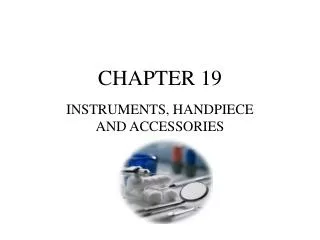
CHAPTER 19 INSTRUMENTS, HANDPIECE AND ACCESSORIES
Hand Instrument • Each hand instrument is made up of three parts, handle, shank, and working end. (pg.315, Table 19-1) • Examination Instruments: allow the dentist to examine the health status of the oral cavity (pg. 315, Table 19-2) • Tooth Preparation Instruments: allows the dentist to manually remove the decay,and to smooth, finish, and prepare the tooth structure to be restored. (Pg. 316, Table 19-3) • Restorative Instruments: allows the dentist to place, condense and carve the dental material to the original anatomy of the tooth. (pg. 316, Table 19-4) Accessory Instruments: versatile instruments that are added to the set up, to make the procedures easier. (Pg.317, Table 19-5)
Instrument Set Up and Care • Box 19-1, PG. 317 • Rotary Instruments: comprise of the dental handpieces and the revolving mechanisms (cutting and finishing burs,etc.) • Two common Handpieces are the Low-speed, High-speed. (19-1, 19-2 pg. 318, 19-3, 19-5 pg 319)
BURS • There are a variety of dental burs. • Burs have three parts: shank, neck and head. See page 321, fig. 19-10 • Each bur can be changed depending on the handpiece • Burs must be sterilized before the next use, dull ones are thrown out. Always place in bur block or holder in the ultrasonic • Types of Burs Pg 322-323, table 19-7 • PG 324 box 19-3, pg 325 fig. 19-11, 19-12