Corrosion
This article explores the fundamental principles of corrosion, highlighting the distinction between anode and cathode pairs in both macro and micro environments. It discusses how differences within materials, such as grain boundaries and segregation, can create micro-cells that influence corrosion behavior. Examples like welds in stainless steel are examined, emphasizing the role of chromium oxide in corrosion resistance and the phenomenon of sensitization. Additionally, methods to suppress corrosion through coatings and cathodic protection techniques are reviewed, providing a comprehensive understanding for engineers and material scientists.

Corrosion
E N D
Presentation Transcript
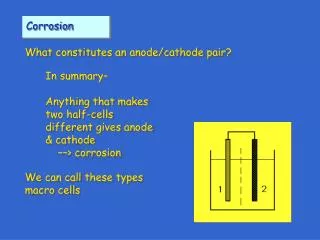
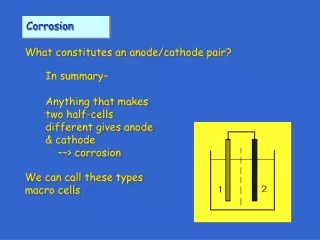
Corrosion What constitutes an anode/cathode pair? In summary– Anything that makes two half-cells different gives anode & cathode ––> corrosion We can call these types macro cells
Corrosion Then what about micro cells? anode & cathode within single material operating on a micro scale Grain boundary - high energy region…anodic wrt bulk of grain Differently oriented grains - some planes of atoms dissolve faster than others Segregation (coring)
Corrosion Then what about micro cells? anode & cathode within single material operating on a micro scale Segregation (coring)
Corrosion Another type or micro cell - 2nd phase 2nd phase will tend to react differently than matrix phase - sets up anode/cathode pair
Corrosion Example - welds
Corrosion corrosion Example - welds 304 stainless steel plate arc- welded to other plates Note corrosion in HAZ Why?
Corrosion Remember…. What makes stainless steel stainless? tight, tenacious film of Cr2O3 on the surface film occludes electrolytes, oxygen
Corrosion Corrosion in stainless steel HAZ due to "sensitization"
Corrosion Decrease C content - no Cr carbide formation Tie up C as Ti carbide (321) or Nb carbide (347) - no Cr carbide formation How to avoid sensitization – get rid of C
Ol' Harold's story 1913 We find Ol' Harold Brearley in England industriously testing alloy steels for gun barrels
Ol' Harold's story Ol' Harold's records showed that the unrusted steel sample contained 14% Cr! The birth of stainless steels! Moral: behind every successful person, there may be a junk pile Stolen from: Tales from Sheffield by Stan Lessteal Cutter Also see Brearley: Steel-makers; and Knotted String (EMS Library)
Suppressing corrosion Components of a cell: anode cathode electrolyte connection
Suppressing corrosion Occlude electrolyte - coatings asphalt greases, oils paints polymers ceramic coatings "noble" metals
Suppressing corrosion Occlude electrolyte - coatings "noble" metals: unless scratch heals, a galvanic cell is set up
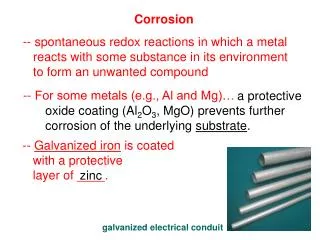
Suppressing corrosion Cathodic protection galvanizing: Zn coating applied by hot-dipping electroplating
Suppressing corrosion Cathodic protection galvanizing: presence of scratch does not promote corrosion of protected metal but steel helps Zn corrode
Suppressing corrosion Cathodic protection set up cell by adding metal which is more anodic than metal or alloy to be protected
Suppressing corrosion Cathodic protection example: protecting ship plate