4.4 Properties of Relations
This article explores fundamental properties of relations in mathematics, including reflexive, irreflexive, symmetric, asymmetric, antisymmetric, and transitive relations. It defines each property with examples, such as the reflexive relation's requirement for cycles at every vertex and the lack of cycles in an irreflexive relation. The article also provides clear graphical representations and matrices to illustrate these concepts, making it accessible for students and enthusiasts of discrete mathematics.


4.4 Properties of Relations
E N D
Presentation Transcript
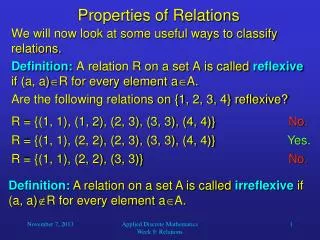
Relations • Reflexive • Irreflexive • Symmetric • Asymmetric • Antisymmetric • Transitive
Reflexive • Reflexive relation has a cycle of 1 at every vertex • A = {1,2,3} B=A • R = {(1,1)(1,2),(2,2),(2,3),(3,3),(3,1)} Reflexive matrix has all 1’s on the main diagonal 1 3 2
Irreflexive • Irreflexive relation has no cycles of length 1 at any vertex. • A = {1,2,3} B=A • R = {(1,2),(1,3),(2,3)} • Irreflexive has all 0’s on its main diagonal 1 2 3
Symmetric • If there is an edge from vertex ito vertex j, then there is an edge from vertex j to vertex i. • A = {a,b,c} B = A • R = {(a,a),(a,c),(b,c),(c,a),(c,b),(c,c)} a c b
a b c • This is a little messy • R = {(a,b),(b,a),(a,c),(c,a),(b,c),(c,b)} • Another way to draw this is: This is a connected digraph This digraph is not connected. R={(a,b),(b,a),(c,d),(d,c)} a c b a c b d
Asymmetric • aRbbRa • A = {1,2,3,4} B = A • R ={(1,2),(3,4),(2,3)} • There is no (1,1) or (2,2) or (3,3) or (4,4) • There is no (2,1), (4,3), or (3,2) • IF mij = 1 then mji = 0 (i = row and j = column) • There are no back arrows. All edges are 1 way streets 1 2 4 3
Antisymmetric • Contains no back arrows. Can contain one node cycles • A = {1,2,3,4} • R = {(1,1),(1,2),(1,4),(3,1),(3,2)} 1 2 3 4
Transitive (tricky) • Every time you have (a,b) and (b,c) you must also have (a,c). • A = {1,2,3,4} • This relation is not transitive: a,bb,c • R = {(1,1),(2,2),(3,3),(4,4),(2,3),(3,4)} • In order to make this relation transitive, you would a,c • need (2,4). • If you have R = {(1,1),(2,2),(3,3),(4,4),(2,3)} is it transitive? Yes, because it doesn’t break the rule. You have (a,b), you don’t have (b,c), therefore you do not need (a,c). Only when you have (a,b) AND (b,c), you must have (a,c).
A cycle is a path where you start and end with the same vertex. • iff is shorthand for if and only if.