Understanding the Theory of Continental Drift by Alfred Wegener
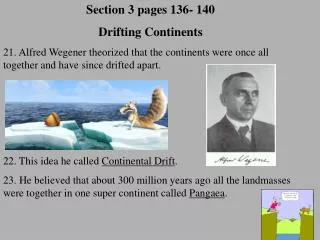
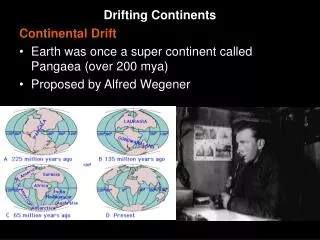
Alfred Wegener, a German scientist, proposed the hypothesis of continental drift, suggesting that all continents were once joined as a single landmass, named Pangaea, and have since drifted apart over time. Evidence supporting this theory includes the alignment of mountain ranges in South Africa and South America, similar fossils (like Mesosaurus and Lystrosaurus) found across distant continents, and climate indications of glaciers in regions such as South America, Africa, India, Australia, and Antarctica. Despite initial rejection by scientists, Wegener’s ideas laid the groundwork for modern geology.


Understanding the Theory of Continental Drift by Alfred Wegener
E N D
Presentation Transcript
4.3 Drifting Continents 9/7/06
I. The Theory of Continental Drift • A. Alfred Wegener, German scientist formed a hypothesis on Earth’s continents. • B. Wegener’s hypothesis was that all the continents had once been joined together in a single landmass and have since drifted apart
C. Pangaea = all lands. • D. Continental drift - the continents slowly move over Earth’s surface • E. Evidence From Landforms Mountain ranges in South Africa lined up with a range in South America.
F. Evidence from Fossils - Fossils are any trace of an ancient organism that has been preserved in rock. Mesosaurus and Lystrosaurus fossils have been found in Africa and South America.
G. Evidence from Climate Glaciers were found in South America, Africa, India, Australia, Antarctica
II. Scientists Reject Wegener’s Theory • Wegener thought that mountains formed when drifting continents collided, causing their edges to crumple and fold. • Mountains usually occur in narrow bands along the edges of continents, as you would expect if the collision of continents forms mountains.