The Synapse: Part II
Dive into the critical mechanisms of myelination in the peripheral nervous system and the processes at play in chemical synapses. This article explores fundamental questions regarding the roles of Schwann cells, the implications of myelination on action potential conduction, and the sequence of events at nerve terminals. With insights into your learning pace and exam performance metrics, this guide aims to enhance your understanding of synaptic transmission and myelin function, crucial for mastering neurobiology concepts.

The Synapse: Part II
E N D
Presentation Transcript
The Synapse: Part II 29 February 2012
Housekeeping Article set 2 available later today Problem set 2 available Friday; due next Friday
Point-Gathering Opportunity! • Take Out Your Clickers!
Which of the following myelinates axons in the PNS? • Schwann cells • Oligodendrocytes • Myelinocytes • Phagocytes • Erythrocytes
Which of the following is a consequence of myelination? • Increased membrane resistance • Increased length constant (l) • Decreased time constant (t) • Faster conduction • All of the above
Which of these fibers conducts action potentials fastest? • Small diameter, unmyelinated axon • Large diameter, unmyelinated axon • Small diameter, myelinated axon • Large diameter, myelinated axon • All of the above conduct at the same rate (“all or none”)
Which of the following happens first? • Voltage-gated Ca2+ channels open • Neurotransmitter is released into the synapse • Action potential arrives at nerve terminal • Vesicle membrane is recycled • Neurotransmitter vesicle is docked
At this point in the semester, I am learning: • Everything • Almost everything • A lot, but missing much • Not very much • Nothing
For me, the pace of the class is: • Way too slow • A little too slow • Just right • A little too fast • Way too fast
The Exam Mean = 119 (83%) Median = 116 Mode = 116 Min = 87 Max = 144
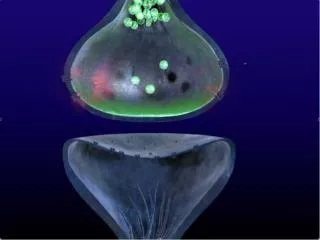
3 2 What happens at the Chemical Synapse 1. NT produced and packaged 2. Vesicle “docked” 3. Action potential arrives 4. Voltage-gated Ca2+ channels open 5. Vesicle fuses with membrane 6. NT released into synapse 7. NT binds to postsynaptic receptors 8. Postsynaptic ion channels open, allowing ions into cell 9. Ion flow changes Vm: “Postsynaptic Potential”