COMMON SENSE
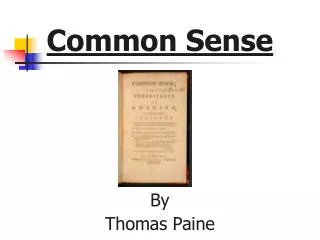
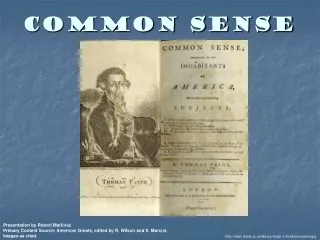
COMMON SENSE. One of the most important factors in convincing many Americans that complete independence was to only way to go was Common Sense by Thomas Paine Mobilized support of “ordinary Americans” for independence . THOMAS PAINE. Came to America in 1774

COMMON SENSE
E N D
Presentation Transcript
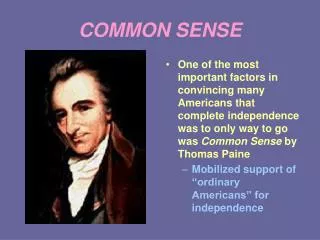
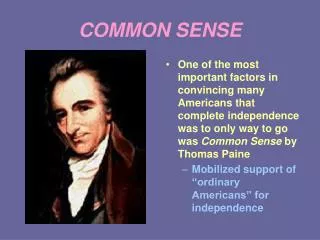
COMMON SENSE • One of the most important factors in convincing many Americans that complete independence was to only way to go was Common Sense by Thomas Paine • Mobilized support of “ordinary Americans” for independence
THOMAS PAINE • Came to America in 1774 • Had been a corset-maker and tax collector in England • Failed in both careers • Marriage also failed • Arrived in Philadelphia • Obtained job with Pennsylvania magazine • Became friends with Dr. Benjamin Rush and John Adams • Men who were privately discussing the idea of independence
TARGET AUDIENCE • Paine decided to bring issues involved in the conflict with England to the mass American audience • Was very successful • Because he came from that same audience • Had been a craftsman and he spoke their language, knew how they thought, and knew what they wanted
WHAT PAINE SAID (I) • Began pamphlet with an attack on the principle of monarchy • Argued that there was no reason why one person should be placed above everyone else because they happened to be born into a certain family
WHAT PAINE SAID (2) • Called on Americans to do away with their king and establish a republican form of government • Did not provide many details • Did say it should have frequent elections, a national legislature, and local legislatures for each state
WHAT PAINE SAID (3) • Argued that British economic policies had crippled American prosperity • Stated that America would never be truly prosperous or “politically great” until it had completely broken from British control • Independent, republican America would start a process of independence for all the people of the world who were not free
POPULARITY OF COMMON SENSE • Went through 25 editions and reached hundreds of thousands of readers in early 1776 • Spread idea of independence from an educated elite to ordinary Americans
THOMAS PAINE: PIONEER • Paine was pioneer in a new style of political writing • Marked by clarity, directness, and forcefulness • Avoided fancy words, Latin phrases, and obscure literary allusions • Aimed his work at ordinary people • Not educated classes • Expressed what they felt in clear terms they could easily understand
CREATING A GOVERNMENT • After the Declaration of Independence was signed, American had to set up a government • Most colonies had already set up provisional local governments based on old colonial assemblies • Changed into permanent state governments after July 4, 1776 • Each with a written constitution
SECOND CONTINENTAL CONGRESS • Second Continental Congress • Convened after Lexington and Concord • Set up special committee after signing of Declaration of Independence to create new national government • Finished in November 1777 • Called the Articles of Confederation
ARTICLES OF CONFEDERATION I • Congress granted power to conduct war, conduct foreign policy, and borrow and print money • Not given power to regulate trade, levy taxes, or draft soldiers • Had to ask states for money and troops
ARTICLES OF CONFEDERATION II • Did not provide for a separate chief executive • Executive committee from members of Congress would enforce laws • Did not create a Supreme Court • Disputes between states were to be settled by a complicated system of arbitration
ARTICLES OF CONFEDERATION III • States retained a large amount of independence and power • Each state legislature elected and paid salaries of its representatives to Congress • Each state only had one vote in Congress • No matter how many representatives it had • Nine states had to be in favor of a piece of legislation for it to pass • All 13 states had to agree before the Articles could be changed
ARTICLES OF CONFEDERATION IV • Ratification of the Articles delayed for fours years because of disagreements • Some states liked document because it provided for a weak central government • Others wanted a stronger central government • Smaller states liked the idea that each state would only have one vote in Congress • Larger states thought that voting power in Congress should be based on population • All disagreements eventually settled by compromise and Articles of Confederation were ratified by Congress in 1781
WHY DID FRENCH HELP? (1) • Not because French government admired American desire for self-government and democracy • Was an absolute monarchy at time and had no representative institutions Louis XVI of France
WHY DID THE FRENCH HELP? (2) • French helped for reasons of power politics • Count of Vergennes realized that England was France’s major enemy • If American colonists gained their independence, British power would be weakened and France would thereby benefit • France had much to gain in a diplomatic sense from an American victory Count of Vergennes
FRENCH AID • French sent military advisors to help train and organize the American army • Marquis de Lafayette • Also secretly provided weapons and ammo • But Americans needed more • Needed more weapons, money, and support of French army and navy • Also needed France to officially recognize America as an independent country Marquis de Lafayette
FRANKLIN IN PARIS • Americans sent Benjamin Franklin to Paris to get stronger commitment from the French • But Vergennes would not commit • Because Americans were losing war with the British and Vergennes did not want to openly back a loser • Would not recognize America as an independent country until colonists gave some indication that they could win • Did agree to provide more money • 68 million dollars over course of war
BATTLE OF SARATOGA • Americans win Battle of Saratoga in December 1777 • British offer peace terms • Franklin played on this to pressure Vergennes into giving him what he wanted • France officially recognized America as independent county • Formed military alliance
BATTLE OF YORKTOWN • October 1778 • American army commanded by Nathaniel Greene and George Washington attack General Cornwallis from one side of Yorktown • French army commanded by Lafayette attack Cornwallis from other side • French navy bombards Yorktown and prevents Cornwallis’ escape by sea • Cornwallis surrendered on October 19, 1778 and the British ask for peace shortly thereafter
SLAVERY • It was only the Revolution and the manpower shortage that resulted in both the British and American armies that transformed the situation of African slaves in the former colonies
MANPOWER SHORTAGE • Royal governor of Virginia announced that he would free all Virginian slaves who would fight on the British side • November 1776 • Thousands of slaves responded to his appeal • More and more British commanders followed his example as manpower shortage went from bad to worse in subsequent months
AMERICAN POLICY • Americans slower to use slave soldiers • Many commanders and political leaders were slave owners and had a lot to lose from this policy • Growing manpower shortage forced change in policy • New England states began to use black recruits • Upper south grudgingly adopted similar policy • Only South Carolina and Georgia refused to use black troops • Because of deep fear of slave rebellion
AFTER THE WAR • Revolutionary War opened opportunities for slaves to gain their liberty that had not existed earlier • When British left, thousands of blacks went with them to Canada or England • Others eluded their American masters and remained free in America • Some American masters kept their word and freed slaves who had fought on American side after the War • Others did not • Many slaves took off for freedom anyway
LIBERTARIAN IDEOLOGY • Libertarian ideology used to justify Revolution challenged institution of slavery • If all men were created equal, then why were some men slaves? • This question bothered some white Americans and made it impossible for them to ignore contradiction between their proclaimed ideology and American reality • Large numbers of white Americans began to question slavery for the first time
CHANGE IN NATIONAL OPINION • Some people freed their slaves and some demanded liberty for all slaves • Pushed slaveowners on the defensive • By 1800, slavery was no longer a national institution and its routine acceptance could no longer be taken for granted • Had become unique only to the South
SLAVERY DISAPPEARS IN THE NORTH • Slavery disappeared first in New England • Where blacks were few in number and not a threat to white dominance • Blacks more numerous in Middle Atlantic states and abolition of slavery therefore more difficult there • Nonetheless, every state north of New Jersey had freed its slaves and abolished slavery by 1804
THE LOWER SOUTH • Some slaveowners in upper South freed their slaves but no state legislature abolished slavery • Even individual emancipations did not occur in Lower South • Demand for slaves actually increased in region • Due to manpower losses, spread of rice cultivation and introduction of cotton growing