Download
1 / 10
100 likes | 230 Views
This presentation delves into the structure and function of DNA, detailing its discovery and significant historical experiments, such as Griffith's mouse experiment and Avery's conclusion on DNA as the transforming principle. It explains the double helix structure, the composition of nucleotides, and the classification of nitrogenous bases into purines and pyrimidines. Additionally, it covers the semi-conservative nature of DNA replication, including the roles of various enzymes like helicases and DNA polymerases in the process.

E N D
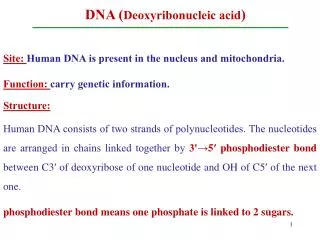
DNADeoxyribonucleic Acid Dr. Jim Bidlack University of Central Oklahoma jbidlack@ucok.edu http://biology.ucok.edu/bidlack Special thanks to John Wilson for providing the template of this presentation in partial fulfillment for Cell Physiology (BIO 4454) during the Fall 2002 Semester.
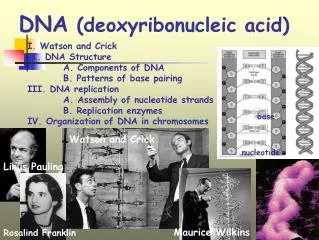
History of DNA • Fred Griffith and the mouse experiment • Transforming “principle” • Oswald Avery’s conclusion of DNA as the transforming principle • Isolation of DNA • Watson & Crick’s Double Helix • Sugar, phosphate, base
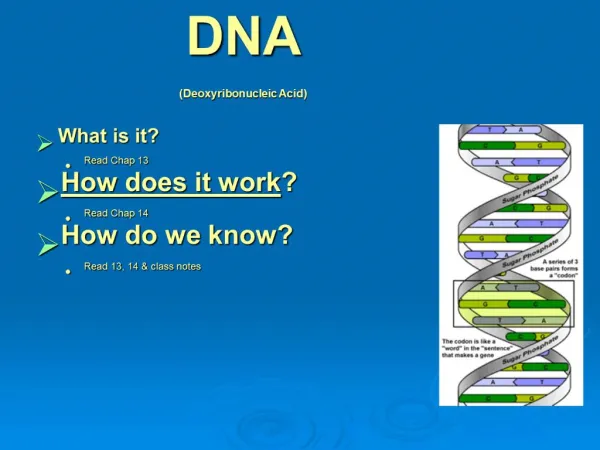
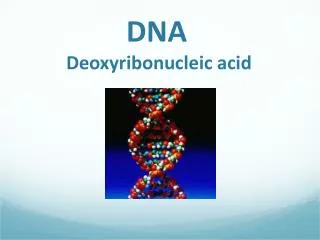
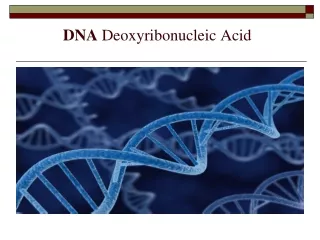
Structure of DNA • DNA is a double helix made of complimentary antiparallel strands • The backbone is constructed of a five carbon sugar and a phosphate group • The rungs consist of the different bases held together by hydrogen bonds
Structure of Nucleic Acids • DNA is a five carbon sugar with two hydrogens on the second carbon • RNA is a five carbon sugar with a hydrogen and hydroxyl group on the second carbon
Structure of the DNA Bases • Two classes of bases: Purines and Pyrimidines • Purines consist of Adenine (A) and Guanine (G) • Pyrimidines consist of Thymine (T) and Cytosine (C) • Bases are the same in RNA except that Uracil (U) is substituted for Thymine
Backbone Linkage • Any nucleotide can be connected with a phosphodiester bond • Nucleotides are triphosphated • The 5’ ends with a phosphate and the 3’ ends with a hydroxyl • The phosphate is attached to the 5’ carbon and the 3’ carbon of the sugar • The bases are attached to the first carbon
DNA Linkage • Helix is anti-parallel and complimentary • Left side is from 5’ end to 3’ end • Right side is from 3’ end to 5’ end • A matches with T stabilized by two hydrogen bonds • C matches with G stabilized by three hydrogen bonds
DNA Replication • Replication is semi-conservative • Each strand is a template for another strand • New DNA strands contain one new strand and one parental strand • Bases on strands are complimentary (A w/ T & C w/ G)
DNA Replication • DNA synthesizes in one direction, from the 5’ end to the 3’ OH end • Many enzymes contribute in the replication of DNA • Helicases - unwind the DNA • Topoisomerases - releases the tension • Single Stranded Binding Proteins - maintain the single strands after unwinding • DNA polymerases - add nucleotides and reads the template strand. There are five polymerases for mammals. Must have a 3’ OH end
Summary • DNA is a double helix with complementary anti-parallel strands • DNA consists of sugar, phosphate and bases • There are two classes of bases: Purines and Pyrimidines • Nucleotides are connected by a phosphodiester bond • Replication is semi-conservative from the 5’ end to the 3’ end and involves several enzymes