Download
1 / 8
80 likes | 234 Views
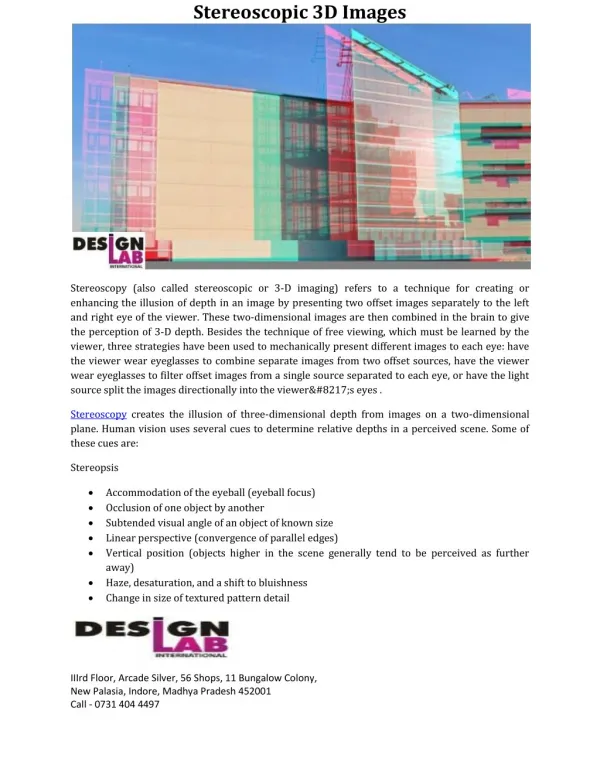
Anaglyph 3D is a stereoscopic technique that uses filters of different colors, typically red and cyan, to create a three-dimensional effect. Each eye views a differently colored image, which, when combined through color-coded anaglyph glasses, produces a cohesive 3D perception. This method is not only popular for entertainment in video games and films but is also utilized in scientific and design applications that require depth perception, such as full-scale and microscopic stereographic images. Discover the fascinating world of 3D imagery!

E N D
3D Stereographic Images Photo 2
What is it? • Anaglyph 3D is the name given to the stereoscopic 3D effect achieved by means of encoding each eye's image using filters of different (usually chromatically opposite) colors, typically red and cyan. • Anaglyph 3D images contain two differently filtered colored images, one for each eye. When viewed through the "color-coded" "anaglyph glasses", each of the two images reaches one eye, revealing an integrated stereoscopic image. The visual cortex of the brain fuses this into perception of a three dimensional scene or composition.
Recently… • Video games, theatrical films, DVDs • Practical images, for science or design, where depth perception is useful, include the presentation of full scale and microscopic stereographic images.