Understanding Slope: Positive, Negative, and Zero in Linear Equations
This overview explores the concept of slope in linear equations, detailing how to identify positive, negative, zero, and undefined slopes. It emphasizes the importance of the slope-intercept form (y = mx + b), where (m) represents the slope and (b) the y-intercept. The guide discusses how to convert linear equations into slope-intercept form using inverse operations, allowing for effective graphing on a coordinate plane. Mastery of these concepts is essential for solving equations and visualizing relationships between variables.

Understanding Slope: Positive, Negative, and Zero in Linear Equations
E N D
Presentation Transcript
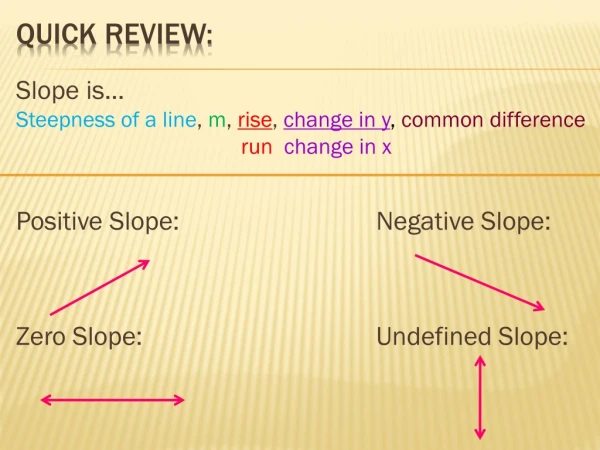
Slope is… Steepness of a line, m, rise, change in y, common difference runchange in x Positive Slope: Negative Slope: Zero Slope: Undefined Slope: Quick Review:
Chapter 12-3 SOLVING FOR Y AND PUTTING EQUATIONS INTO Slope - Intercept Form
Any linear equation can be graphed on a coordinate plane. • In order to be able to graph the equation, it has to be set up properly. • Doctor / surgery • Driving • Vacation • The ONLY way to graph an equation is from slope-intercept form. CONCEPT:
y = mx + b Slope y-intercept **Slope-intercept form: y= mx+ b mis the slope and bis the y-intercept. m and b are place holders for numbers. In slope-int. form, m & b will be numbers
y = 6x + 2 y = x - 5
Slope-intercept form is how you need an equation to be so that you can EASILY graph it. Standard form is another way of seeing a linear equation, but you can’t graph it – you would have to put it into slope-intercept form.
To put any linear equation into slope-intercept form, you have to use inverse operations to solve for y.
You must always have y, m, x, and b. This means that if an equation says y=mx, you assume that b is 0 (and add 0). y = mx + 0
Change to slope-intercept form: 4x + 3y = 9
-5x – 9x = 4y – 4 -6y – 2x = 8 7y – 7x = -4 1y – 3x = 4