Download
1 / 16
160 likes | 295 Views
Engage in a hands-on exploration of covalent and ionic bonding! You will independently draw Lewis dot structures for SiO2, PF3, N2, and C2H4 in your notes. After that, visit 11 questioning stations focusing on various bonding concepts. Move at your own pace, answer all the questions on your handout, and return to your desk once completed. Topics include predicting electrical conductivity, identifying chemical compounds, and analyzing bond types. This activity aims to deepen your understanding of bonding and molecular structures.

E N D
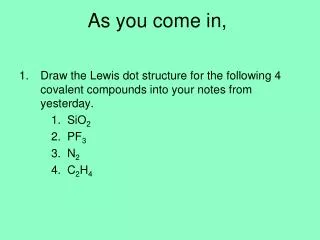
As you come in, Draw the Lewis dot structure for the following 4 covalent compounds into your notes from yesterday. SiO2 PF3 N2 C2H4
You have 30 minutes. Visit the 11 ionic and covalent bonding questioning stations. Answer all of the questions independently on your handout. Move at our own pace. You do not have to go to the stations in order. Return to your desk when you are done.
Station One Which of the following chemical formulas is incorrect? Why? • KNO3 • MgSO3 • AlP • RbO2 • Li2O • Na2ClO3 Level 6 Question
Station Two Predict which of the following chemical compounds would conduct electricity. Why? • H2O • CO2 • CaCl2 • NaOH • SCl2 • Fe2O3 Level 3 Question
Station Three Name the following chemical compounds. • Zn3(PO4)2 • NH4CN • P2O5 • CuS • NO3 • Mn(CO3)2 Level 2 Question
Station Four Which of the following chemical compounds is held together by an electrostatic attraction? • Dihydrogen monoxide • CoCl3 • Potassium selenide • AgCl • Phosphorus trichloride • Cesium peroxide Level 3 Question
Station Five Which of the following chemical compounds is a molecule? • Tin (IV) oxide • Silicon dioxide • BaSO4 • Nitrogen trioxide • MgO • CrCO3 Level 2 Question
Station Six Name the nonmetal with only 1 valence electron. Level 1 Question
Station Seven How many electrons are shared in a carbon tetrachloride molecule? Level 4 Question
Station Eight How many lone pairs are on a water molecule? Level 4 Question
Station Nine What element is found in the terminal position in NH3? What element is central? Level 3 Question
Station Ten Which illustration represents an ionic bond? Why? Level 6 Question
Station Eleven Which of the 7 diatomic molecules have identical Lewis dot structures? Why? Level 6 Question
VSEPR, Polarity, and IMF Review • CCl4 • H2O • NH3 • CO2
Acid Review • When will I use “hydro-”? • Chlorous acid • Hydrofluoric acid • Acetic acid • Nitric acid
Exit Questions • Draw the Lewis structure for SeCl2. • Name AuP. • Write the formula for oxygen difluoride. • Which of the following is covalently bonded? • PCl3 • AlCl3