Understanding RSA Cryptography: Principles and Key Generation
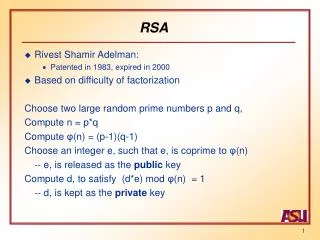
RSA cryptography, patented in 1983 and expired in 2000, relies on the difficulty of factoring large integers. It starts by choosing two large prime numbers, p and q, from which n is computed as their product. The totient φ(n) is determined by (p-1)(q-1). A public key integer e is chosen such that it is coprime to φ(n). The private key d is computed to satisfy (d*e) mod φ(n) = 1. RSA enables secure encryption and decryption of messages using modular exponentiation, ensuring that (m^e)^d mod n = m.

Understanding RSA Cryptography: Principles and Key Generation
E N D
Presentation Transcript
RSA • Rivest Shamir Adelman: • Patented in 1983, expired in 2000 • Based on difficulty of factorization Choose two large random prime numbers p and q, Compute n = p*q Compute φ(n) = (p-1)(q-1) Choose an integer e, such that e, is coprime to φ(n) -- e, is released as the public key Compute d, to satisfy (d*e) mod φ(n) = 1 -- d, is kept as the private key
RSA • Encryption (of message m) (m)e mod n • Decryption (of cipher m’) (m’)e mod n • RSA property ((m)e)d mod n = m