Fundamentals of Decision Support Systems for Managers and Developers
This course equips students with essential knowledge of Decision Support Systems (DSS), integrating disciplines such as mathematical models, expert systems, and data mining. It includes an overview of management support systems, the DSS development process, data management strategies, and user interface design. Students will explore various modeling techniques and applications of neural networks in DSS. The curriculum emphasizes the importance of critical success factors, human cognition, and group decision-making processes. Ideal for aspiring managers and information systems developers.

Fundamentals of Decision Support Systems for Managers and Developers
E N D
Presentation Transcript
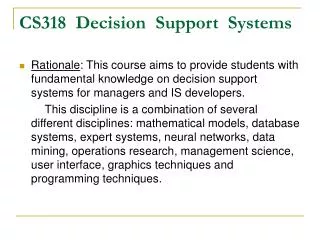
CS318 Decision Support Systems • Rationale: This course aims to provide students with fundamental knowledge on decision support systems for managers and IS developers. This discipline is a combination of several different disciplines: mathematical models, database systems, expert systems, neural networks, data mining, operations research, management science, user interface, graphics techniques and programming techniques.
Course Outline: PART A • I Management support systems: An Overview • 1. Managers and Computerized Support • 2. Decision Support Systems (DSS) • 3. Development process of a DSS • II Systems, Mathematic Models, and Decision Support • 1. Systems • 2. Models • 3. The Modeling Process • 4. Critical Success Factors • 5. Human Cognition and Decision Styles • 6. Making Decision in Group • III Decision Support Systems : An Overview • 1. The Illustrative case for DSS • 2. Introduction: What is a DSS; • 3. Characteristic and Capabilities of DSS • 4. Components of DSS • 5. Classification of DSS and Their Support
IV Data Management • 1 Sources of Data • 2. atabase and Database Management Systems: An Introduction • 3 Fourth-generation Systems • 4 Object-oriented Databases • 5.Enterprise Decision Support and The Information Warehouse • 6.Intelligent Databases • V Modeling and Model Management • 1. Modeling in MSS • 2. Static and Dynamic Models • 3. Treating Certainty, Uncertainty, and Risk • 4. Types of Modeling: Decision Trees, Mathematical Programming, Simulation, Heuristic Programming, Influence Diagrams, Forecasting, Spreadsheet, Multi- dimensional Modeling • 5. Model Base Structure and Management • VI User Interface • 1. User Interfaces: An Overview • 2. Interface Modes (Styles): Graphics and Graphical User Interface (GUI), Multimedia and Hypermedia, Visual Interactive Modeling, Virtual Reality • 3. Geographical Information System (GIS) • 4. Natural Language Processing: An Overview and Methods • 5. Research on User Interface in MSS
VII Constructing a Decision Support System • 1. Development Strategies • 2. The DSS Development Process: Life Cycle versus Prototyping • 3. Team-developed versus User-developed DSS • 4. End-User Computing and User-developed DSS • 5. Selection of a DSS Generator and Other Software Tools • 6. Developing DSS in the Windows Environment PART B • VIII Data Warehousing • 1. Basic concepts of data warehousing • 2. Data warehouse architectures • 3. Some characteristics of data warehouse data • 5. The reconciled data layer • 6. Data tranformation • 7. The derived data layer • 8. The user interface • IX Data Mining • Overview on data mining • Association rules • Classification • Clustering • Some other data mining problems
X Neural Networks in Decision Support • 1. Introduction • 2. ANN representations • 3. Perceptron Training • 4. Multilayer networks and Backpropagation algorithm • 5. Remarks on the Backpropagation algorithm • 6. Neural network application development • 7. Benefits and limitations of ANN • 8. ANN Applications in decision support References [1] Turban, E., Aronson,J.E., Decision Support Systems and Intelligent Systems- 6th Edition, Prentice-Hall, 2001. Instructors: Part A: Dr. Le Van Duc Part B: Assoc. Prof. Dr. Duong Tuan Anh