Statistical Framework for Meningioma Cancer Diagnostic
Explore statistical methods for detecting meningioma tumors. Analyze SEREX and microarray data. Study genetic alterations and use Bayesian statistics. Develop prediction models for tumor classification.

Statistical Framework for Meningioma Cancer Diagnostic
E N D
Presentation Transcript
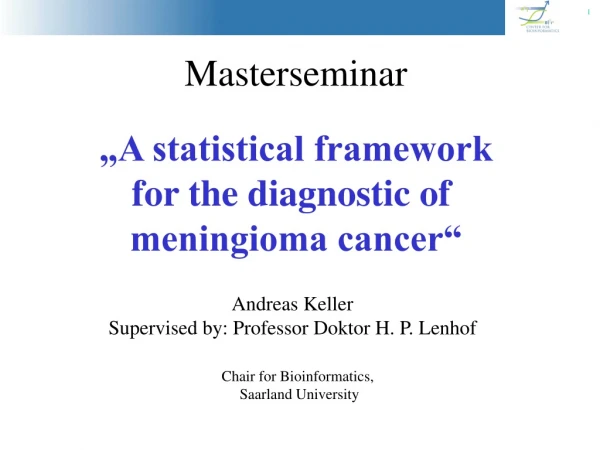
Masterseminar „A statistical framework for the diagnostic of meningioma cancer“ Andreas Keller Supervised by: Professor Doktor H. P. Lenhof Chair for Bioinformatics, Saarland University
Outline Outline • Introduction • Materials and Methods • SEREX • Microarray • Conclusion • Discussion
Introduction • What are meningiomas • Benign brain tumors • Arising from coverings of brain and spinal cord • Slow growing • Most common neoplasm (brain) • Genetic alterations
Introduction meningioma in proportions • Two times more often in women as in men • More often in people older than 50 years
Outline Outline • Introduction • Materials and Methods • SEREX • Microarray • Conclusion • Discussion
SEREX serological identification of antigens by recombinant expression cloning se ex r
SEREX – Identification expression of a human fetal brain library proteins bind on membrane pooled sera detection 2nd antibody
SEREX – Screening agar plate specific genes patients serum 2nd antibody detection
Microarrays • System: • cDNA microarrays • 55.000 spots • Whole Genome Array • Data: • 8 samples per WHO grade • 2 dura as negative controle • 2 refPools as negative controle
Statistical Learning • Supervised Learning • Bayesian Statistics • Support Vector Machines • Discriminant Analysis • Unsupervised Learning (Clustering) • Feature Subset Selection • Component Analysis (PCA, ICA)
Statistical Learning • Crossvalidation • Error Rates • Training Error • CV Error • Test Error • Specificity vs. Sensitivity tradeoff • Receiver Operating Caracteristic Curve
Outline Outline • Introduction • Materials and Methods • SEREX • Microarray • Conclusion • Discussion
SEREX • Data situation: • p = 57 • n = 104 • Goal: • Predict meningioma vs. non meningioma • Predict WHO grade
Bayesian Approach class gene A gene B serum 1 serum 2 serum 3 serum 4 serum 5 serum 6 serum 7 serum 8 serum 9 serum 10 serum 11 serum 12 1 0 1 1 1 1 2 1 1 2 1 0 3 0 1 3 1 0 0 0 0 0 0 0 0 1 0 0 0 0 0 0 0 0 0 0
Bayesian Approach class gene A gene B serum 1 serum 2 serum 3 serum 4 serum 5 serum 6 serum 7 serum 8 serum 9 serum 10 serum 11 serum 12 1 0 1 1 1 1 2 1 1 2 1 0 3 0 1 3 1 0 0 0 0 0 0 0 0 1 0 0 0 0 0 0 0 0 0 0 4 4 6 6 1 1 6 7 4 4 6 6 1 0 6 6
Bayesian Approach class gene A gene B serum 1 serum 2 serum 3 serum 4 serum 5 serum 6 serum 7 serum 8 serum 9 serum 10 serum 11 serum 12 1 0 1 1 1 1 2 1 1 2 1 0 3 0 1 3 1 0 0 0 0 0 0 0 0 1 0 0 0 0 0 0 0 0 0 0 2 2 6 6 5 6 6 6
SEREX Conclusion • Separation meningioma vs. non meningioma seems very well possible • Separation into different WHO grades seems to be possible with a certain error
SEREX Conclusion • Extend to other • Brain tumors (glioma) • Human cancer • Disease • Simplify experimental methods • Develop a prediction system
Outline Outline • Introduction • Materials and Methods • SEREX • Microarray • Conclusion • Discussion
Microarray • Data situation: • p = 53423 • n = 26 • 2 goals: • Find significant genes • Classify into WHO grades
Dimension reduction 6 approaches • Component analysis • Take genes which differ from DURA • Take genes which differ from refPool • Take genes which differ between grades • Take „publicated“ genes • Split into chromosomes
Component analysis • Principal component analysis • Independant component analysis
Analysis of grades tissues genes
Dura and refPool • Justification for Dura • Wherefrom to take? • How to take? • Genes different from normal tissue • Good to classify into meningioma vs. healthy • Justification for refPool • Genes different between WHO grades • Good to classify into grades
Published genes • Several 100 genes are connected with meningioma in several publications • Find these genes and investigate them • example: Lichter 2004 – 61 genes with different expression WHOI in contrast to WHOII and III
Split into chromosomes • losses: • 22 • 1p • 6q • 10q • 14q • 18q • gains: • 1p • 9q • 12q • 15q • 17q • 20q • As mentioned: often karyotypic alterations => Split genes into different chromosomes => Compare to karyotype
Classification • Classification: • Clustering • SVM • Discriminant Analysis • Least Squares
BN++ • BN++ as a statistical tool • Build a C++/R interface?? • Use MatLab?? • Use C++ librarys??
Outline Outline • Introduction • Materials and Methods • SEREX • Microarray • Conclusion • Discussion
Workflow • Large scale investigation of suspicious people by antigen analysis. • If a positive prediction is made do further analysis (CT or similar). • If necessary surgory. • Further examinations with the gained tissue.
Outline Outline • Introduction • Materials and Methods • SEREX • Microarray • Conclusion • Discussion
Outline Outline • Introduction • Materials and Methods • SEREX • Microarray • Conclusion • Discussion